


A quagmire on a swampy battlefield: What Wolfbrook actually walked into at Pegasus

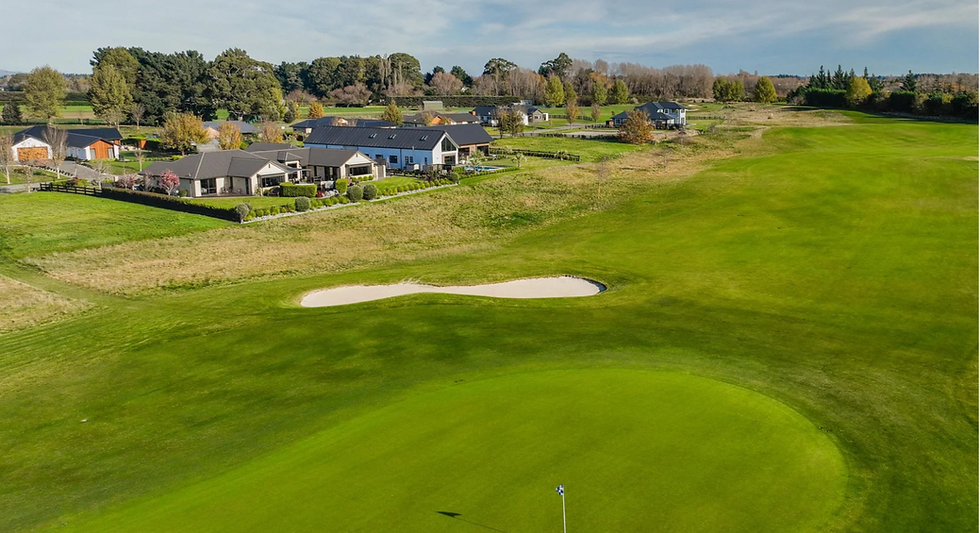
Since yesterday's article, I have taken a closer look at the wider environment, the industry, and realised that there's a lot more to Pegasus than a developer wanting to carve up a golf course.
Wolfbrook appears to have thought it was buying a fast rezoning play in a depressed regional market. What it actually bought is a high watertable site on contested land between Kaiapoi Pā and Tūtaepatu Lagoon, opposite a township of organised retirees whose figurehead is Sir Richard Hadlee, with the integrity of an entire master-planned consent on the line, in an election year, twenty minutes from another residential golf-course development whose parent company has just collapsed.
It is a quagmire on a swampy battlefield. The smart move now is not the rezoning. It is the deal the residents broker before the rezoning ever gets filed.
Contents
What Wolfbrook actually walked into
How the liquidation actually happened
The timing of the Wolfbrook donation
Where is the local MP, and why does it matter?
Clearwater: the parallel that should worry everyone
Where else the Crown has fixed structurally broken sectors
What’s actually changing about housing and recreation
What Wolfbrook actually walked into
Wolfbrook Property Group bought 77.66 hectares of failed championship golf course in early 2026 at a price that only works if the land can be rezoned for housing. Reading the public record, the company appears to have treated this as a straightforward play: distressed asset, motivated liquidator, sympathetic government, fast-track legislation on the statute book. Pay $6–7 million, lodge a rezoning, walk away with land worth multiples of that. Easy. Done by Christmas.
Five things suggest it will not be easy. They were all knowable before the cheque was written.
The zoning
The land sits in the Special Purpose Zone (Pegasus Resort), notified in 2021 and confirmed through hearings in 2025. The SPZ contains seven activity areas — none of which permit general residential subdivision across the holes.
The Bayleys listing itself identified only 5.86 hectares across three super lots as the development envelope, for accommodation and tourism use.
That is the envelope Wolfbrook bought into.
The other 71.8 hectares would require either a private plan change — publicly notified, submissions, hearings, Environment Court appeal rights — or a Fast-track Approvals Act referral that the Minister for Infrastructure’s office has already told the Herald is not on its radar.
Either way, the council would have to walk away from a plan it confirmed months ago.
The watertable
Pegasus sits on land with a high water table. The 80 hectares of permeable grassed fairways were not a decorative choice — they are the township’s stormwater sponge during rain events. Replace them with townhouse pads, driveways, roofs and roads, and the absorption capacity collapses.
The rainfall does not change.
The water table does not move.
The only variable is where the runoff goes — onto neighbouring lots, into council infrastructure not designed for this load, or onto State Highway 1 to the west.
Any rezoning application without a costed, modelled, council-engineer-signed stormwater management plan for the full build-out should not be considered notifiable. That alone is a one-to-two-year piece of work.
The land itself
The site sits directly between Kaiapoi Pā — a major Ngāi Tahu pā sacked in 1832 and now a Heritage New Zealand Category 2 memorial reserve — and Tūtaepatu Lagoon, returned to Ngāi Tahu under the 1998 settlement and now administered by Te Kohaka o Tuhaitara Trust. The local mana whenua are Ngāi Tūāhuriri.
Any earthworks on this land trigger archaeological authority requirements under the Heritage New Zealand Pouhere Taonga Act 2014 and consultation obligations under Ngāi Tahu’s settlement instruments.
There is no plausible reading of those obligations under which cookie-cutter housing across 77 hectares passes through unchallenged. The 1832 fall of Kaiapoi is a deeply significant event in Ngāi Tahu’s recent history. Building over its margins is not a battle the iwi will sit out.
The opposition
Sir Richard Hadlee — inaugural member number one of the Pegasus golf club, builder of the first house on the course in 2010, “shocked and devastated” — is not a man who scares easily, does not need the money, has media access most applicants would envy, and has an existing public relationship with Ryman Healthcare. The nearby retirement village is named after Sir Richard.
The Pegasus Guardians are funding green-keeping out of their own pockets at $150 a month each. The Pegasus Residents Group Incorporated has 15 years of community organising behind it and a charitable infrastructure already running.
The demographic Wolfbrook needs to outlast is equity-rich, time-rich, and increasingly well-advised.
The calendar
This is an election year. Wolfbrook donated $40,250 to the New Zealand National Party on 23 April 2026, disclosed on the Electoral Commission’s election-year-over-$20,000 donations return nine working days later.
RNZ has already documented that companies and shareholders associated with 12 fast-track projects donated more than $500,000 to the coalition parties.
A National Party government heading into an election does not want a high-profile story about a Christchurch developer with a fresh donation to the party trying to fast-track residential housing across a wāhi tapu site, against the express wishes of Sir Richard Hadlee.
That is the kind of story that runs nationally for a week.
It is also the kind of story that opposition campaigns use in mailers.
The political risk to the applicant’s preferred pathway is now substantially higher than the planning risk.
A quagmire on a swampy battlefield, in other words.
And that is before the structural problem with the entire residential-golf-course development model is engaged — the problem that produced Pegasus, that has just produced Clearwater, and that will produce the next one if nothing changes.
My earlier column framed Pegasus as cannibalisation. The closer view is that cannibalisation is the symptom. The disease is the way these developments have been consented, governed and operated in this country for twenty years.
How the liquidation actually happened
Pegasus Golf Ltd was placed into voluntary liquidation on 2 March 2026, with Tony Maginness and Jared Booth of Baker Tilly Staples Rodway appointed as liquidators. The course was owned by Auckland businessman Xiangming (Sam) Huo through his company Sports and Education Corporation Ltd. He paid $14.8 million for it in 2018. The adjoining 6-hectare resort site — intended for a $100 million resort development that never materialised — was put up for mortgagee sale in November 2025 and the club itself was offered for sale by the mortgagee in February 2026, before voluntary liquidation followed weeks later.
The liquidator’s report shows the club owed approximately $9 million to creditors. Secured creditors were owed more than $6 million. Unsecured debt of more than $2.25 million included related-party loans and significant arrears to Inland Revenue for GST and PAYE.
That tax-arrears detail matters.
Residents have described the trading operation as profitable but poorly run; the proximate trigger for liquidation was an unpaid tax position, not a failure of the underlying golf business. The course was generating revenue. It was just bleeding capital out the back door through the corporate structure that owned it.
Receivers entered the property in mid-March and removed equipment. Greenkeeping jobs were lost. A volunteer group, the Pegasus Guardians, has been keeping the course playable out of their own pockets since.
Multiple parties bid for the asset — including, residents say, operators with golf-course experience who pledged to keep the course open — and the receivers preferred the bid that didn’t. That preference was rational from the receivers’ narrow duty to maximise the return to secured creditors. It was disastrous for everyone else with skin in this game.
The timing of the Wolfbrook donation
Wolfbrook Limited, of Unit L1, 10 Show Place, Addington, Christchurch, donated $40,250 to the New Zealand National Party. The donation was received on 23 April 2026 and disclosed on the Electoral Commission’s election-year-over-$20,000 donations return, signed by National Party general manager Jo de Joux on 6 May 2026. That return was filed nine working days after receipt — well inside the 20-working-day disclosure window. Procedurally, it is clean.
The timing speaks for itself. Wolfbrook acquired the 77.66-hectare Pegasus parcel in the same window. Within weeks of completing the purchase, the company’s CEO Guy Randall confirmed to the New Zealand Herald that the company intended to apply for the land to be rezoned for housing. The Fast-track Approvals Act 2024 provides a mechanism for that rezoning to bypass the council with a single-shot panel decision and no merits appeal. RNZ has already documented that companies and shareholders associated with 12 fast-track projects donated more than $500,000 to the coalition parties.
Wolfbrook’s $40,250 to National in the month a rezoning ambition was publicly disclosed sits within that established pattern. It does not establish causation. It does establish that the pattern is alive and well in 2026, and that Pegasus is now part of it.
Where is the local MP, and why does it matter?
Pegasus sits in the Waimakariri electorate. The local MP is Matt Doocey, a third-term National MP, Minister for Mental Health, and member of one of Canterbury’s most established National Party families — the nephew of former Speaker David Carter and grandson of long-serving Christchurch City Councillor Maurice Carter. In the January 2025 reshuffle he lost three of his four ministerial portfolios — ACC, Tourism and Hospitality, and Youth — keeping only Mental Health. He is a competent, constituency-focused MP without a list backup and without a portfolio that protects him from a serious electoral contest.
Waimakariri also swings hard.
Doocey won the seat by 2,500 votes in 2014, by over 10,000 in 2017 (the largest personal vote increase in the country that year), held it by just 1,507 votes in the 2020 Labour landslide — in a year Labour took 49 per cent of the Waimakariri party vote to National’s 28 — and won it back by 13,010 votes in the 2023 counter-swing.
The electorate moves with the national tide more than most.
Waimakariri’s boundaries are also among the 19 unchanged general electorates under the 2025 Representation Commission review, so there is no redrawn-map effect to fall back on. Doocey’s 13,010-vote margin looks impregnable on paper. It looked impregnable in 2017 too, before it collapsed to 1,507 three years later.
For the first two months after the Wolfbrook acquisition broke, Doocey's public footprint on the controversy was invisible. No media statement, no press release, no Facebook post on his official channels engaging with what was by some distance the biggest planning story in his electorate this term.
On 21 May 2026, while leading a New Zealand Trade and Enterprise delegation in Australia, he broke that silence with a Facebook statement opposing the Wolfbrook proposal on three grounds:
the golf course has economic significance to the wider Waimakariri district,
housing development belongs in the right places and Waimakariri already has competing land available, and
the course is "pivotal to the identity of Pegasus."
His statement explicitly noted that "consents are already in place to develop accommodation, conference and event facilities" — an endorsement, in the local MP's own words, of the existing Special Purpose Zone envelope and a rejection of the rezoning ambition that justified Wolfbrook's purchase price.
It is a finely judged statement.
He has backed his residents on the development question without saying anything about:
the Wolfbrook donation to his own party,
the Fast-track Approvals Act architecture his government legislated,
the donor pattern across the wider fast-track project list,
the wāhi tapu obligations the site engages, or
the structural failure across the residential-golf-course model that has just produced Clearwater alongside Pegasus.
He has executed the minimum political positioning required to be on the right side of his constituents in an election year, without picking a fight with his party, his Cabinet, or its donor base.
Whoever advises him on this stuff knew exactly what they were doing. The position is defensible, narrow, and timed for his own convenience rather than the residents' campaign cycle.
It also commits him, for the first time, to a public stance that constrains his options if Wolfbrook escalates — by private plan change, by fast-track referral, by litigation.
Every escalation from this point becomes a story about whether the local MP can deliver on the position he has just stated.
Doocey will be assumed by his party to have a strong counter-asset: the SH1 Belfast to Pegasus Motorway and Woodend Bypass, a $1.5 billion Road of National Significance that NZTA endorsed in November 2024 and that began early works construction in March 2026. The project four-lanes 11 kilometres of SH1, replaces the Pegasus roundabout with an overbridge and signalised interchange, and bypasses Woodend altogether.
When Transport Minister Chris Bishop and Associate Transport Minister James Meager announced geotech work in May 2025, Doocey was named first in a list of five Canterbury MPs and Mayor Dan Gordon thanked as "staunch advocates" of the project.
On the conventional reading, this is political gold. Hi-vis vests on the verge, ribbon-cuttings for the early works package, traffic-flow improvements branded as a National delivery. The 13,010-vote margin should be the floor, not the ceiling.
The unconventional reading is more interesting, and Wolfbrook’s lawyers will already be aware of it. The motorway is the infrastructure that makes Wolfbrook’s land-banking play pencil up in the first place. A four-lane motorway with a Pegasus overbridge cuts the practical drive time to Christchurch employment and turns Pegasus from amenity-led township into commuter dormitory. Wolfbrook would not have paid $6–7 million for the 77.66-hectare parcel without near-certainty that the motorway was being built.
The motorway and the rezoning are not parallel stories — they are causally linked through the value-capture logic.
A local MP who champions the motorway is implicitly providing the value justification for the rezoning his constituents are fighting. He is also implicitly endorsing Wolfbrook’s commuter-dormitory framing of what Pegasus is, against the residents’ township-led framing. The original 2006 master plan sold Pegasus as a self-contained community with its own lake, course, schools and town centre. The bypass model contradicts that vision. Doocey is on the bypass side of the argument by virtue of the credit he is going to claim.
The timing also runs against him.
NZTA has confirmed that main construction begins in late 2026 — i.e. during or immediately after the campaign — with the project expected to take four years. The visible motorway story through the election year is mostly disruption: geotech rigs, property acquisition, road closures around Pineacres and Williams Street, construction signage and traffic management. The ribbon-cuttings and travel-time-saved stories do not arrive until 2027 or 2028. The motorway as deliverable is a 2029 election story.
The motorway as 2026 campaign material is mostly “trust us, this will be great.”
A bigger structural problem: NZTA’s main works consent applications were lodged in early 2026 under the Fast-track Approvals Act. If Wolfbrook also routes its Pegasus rezoning through fast-track, both projects will sit on the same FTAA list in the same electorate. The FTAA’s political reputation in Waimakariri will be bound to both. Bad press on one contaminates the other. Doocey cannot uncouple them.
The net effect is that the motorway probably saves Doocey one to two thousand votes he would otherwise lose.
It does not insulate him from a national swing against the National Party.
It does not neutralise the Pegasus and Clearwater story arc.
And it does not protect him from the question that follows from his 21 May statement:
with a fast-track motorway in his patch and a donor-developer trying to rezone a championship course next to wāhi tapu, can the local MP actually deliver on the opposition he has now publicly stated, or is the principled position destined to be overridden by the Cabinet and the FTAA architecture his own government built?
This matters beyond Waimakariri.
The National Party campaigns, structurally and explicitly, on maintaining the momentum of the property sector — the explicit version of this is Christopher Luxon’s public preference for “steady, consistent increases in property values” and Nicola Willis telling Auckland buyers they should “absolutely” buy a house.
The implicit version is the funding base I documented in “The overhang trap” — a donor network that depends on continued land-value appreciation in the Auckland northern growth corridor and Canterbury greenfields.
The model is fragile.
Two high-profile residential golf-course developments in the same region failing in the same quarter, with one of them being publicly cannibalised by a Wolfbrook with a fresh National Party donation on the disclosure list, is precisely the kind of story that punctures the property-momentum narrative the campaign needs to maintain.
There is a deeper structural point underneath that political one.
Most of New Zealand’s greenfield residential developments — Pegasus, Clearwater, Hobsonville, Long Bay, Millwater, Pegasus’s Auckland cousins around Kumeu and Warkworth — are built on featureless land that creates its own amenity and provides its own infrastructure. There was no lake at Pegasus before 2006. There was no golf course. There was no town centre, no walking tracks, no recreational draw. Every element of the township’s amenity was manufactured by the developer’s consent. The land was flat farm paddocks with a high water table. What now sells for premium prices is the consented landscape, not the underlying dirt.
When that amenity and its associated infrastructure — stormwater, drainage, irrigation, road and reserve vesting, the body responsible for ongoing maintenance — is not properly managed, the consequences cascade. The course fails, and with it the amenity premium.
Stormwater capacity fails, and the residential lots flood. The body that was meant to fund maintenance collapses, and the ratepayer inherits the bill.
The developer who sold the original lots is long gone. The residents who paid premiums for a vision are left with the receivership documents. That is not a hypothetical. It is exactly what happened at Pegasus, and is happening at Clearwater.
The question for every other manufactured greenfield community in the country is whether the consent that built their amenity contained enough binding architecture to keep it operating once the original developer walked away. In most cases the honest answer is no.
This is the political risk Doocey carries into the election year and the reason his silence is structurally untenable.
If Pegasus goes sideways — if the fast-track happens, or if Wolfbrook lodges a private plan change the council waves through, or if another candidate runs the failure of the master-planned vision as the local centrepiece — the question Doocey will be asked at every public meeting is what he did, as the local MP and a Cabinet Minister, to protect the consents the residents paid premiums to rely on.
Hope is not an answer.
Silence is not an answer.
And if Clearwater’s parent-company collapse produces further bad news through 2026, the broader story — that the residential-golf-course model has structurally failed in Canterbury and that the government has done nothing to fix it — attaches to whoever is the visible local incumbent. That is Doocey by default.
Clearwater: the parallel that should worry everyone
In the same window as the Pegasus collapse, Clearwater Land Holdings Ltd — the property-holding entity associated with Christchurch’s Clearwater Resort and Golf Club, former home of the BMW New Zealand Open and the ISPS Handa NZ Women’s Open — was placed into liquidation by special resolution of its shareholders. The company is reported to have $30 million in related-party debt. The course itself, sensibly, was sold to its members for $3 million back in 2009 — development costs of the course alone had been $15 million — because the club board recognised that being “in the hands of the developers” was a structurally unsustainable position. That foresight is now the only reason Clearwater’s greens are still being watered while its parent company is being wound up.
Two of New Zealand’s most prestigious residential golf courses, twenty minutes apart, both in liquidation within weeks of each other in 2026, both produced by versions of the same business model. That is not a coincidence. NZ Golf Business has been warning about a “silent crisis” across the sector for over a year — governance failures, debt structures that decouple the operating company from the residential lots it serves, no levy mechanism tying property ownership to course maintenance, and corporate entities that fail upward into receivership while leaving residents holding amenity premiums that depend on the failed operation.
Pegasus and Clearwater are the front of the wave, not the whole of it.
Where else the Crown has fixed structurally broken sectors
This is the part the Pegasus residents need to understand and the part the government needs to be reminded of. New Zealand has, repeatedly and recently, intervened to fix sectors where private collective arrangements were failing the people inside them.
The Retirement Villages Act 2003 was reviewed by the Ministry of Housing and Urban Development. The review attracted more than 11,000 submissions, Cabinet made decisions in late 2025, and the Retirement Commissioner has welcomed reforms covering occupation right agreements, repayment timeframes, dispute resolution, and unfair contract terms. Residents in retirement villages were structurally vulnerable to operator failure and contractual asymmetry. The Crown stepped in.
The Unit Titles Act 2010 was substantially amended by the Unit Titles (Strengthening Body Corporate Governance and Other Matters) Amendment Act 2022, with final provisions in force from 9 May 2024. The reforms required 30-year long-term maintenance plans for large developments, mandatory long-term maintenance funds, codes of conduct for body corporate managers, and MBIE monitoring powers including pecuniary penalties. The Crown recognised that private collective property arrangements need statutory backbone to prevent operator capture and structural failure.
The racing industry was rescued by the Racing Industry Amendment Act 2024, which extended TAB NZ’s monopoly to online betting and ratified a 25-year partnership with Entain delivering more than $1 billion in racing-industry funding over five years, plus a $20 million one-off payment to Sport NZ. The argument was that an entire industry employing 14,000 New Zealanders would collapse without statutory protection of its revenue model. The argument worked.
The film industry has the New Zealand Screen Production Grant, recently extended and broadened.
The fisheries industry has the Quota Management System.
Major sporting and cultural events get one-off funding through MBIE’s Major Events Fund. Eden Park has been the recipient of repeated central-government interventions.
The principle is consistent: where a sector produces clear public benefit but cannot sustain itself under its current commercial structure, the Crown steps in with statutory or financial scaffolding.
There is a sharper version of this argument, and Pegasus brings it into clear focus. The proximate trigger for the Pegasus Golf Ltd liquidation was IRD arrears for GST and PAYE — a tax compliance failure.
Compare that against how the Crown handles tax in sectors it considers worth protecting.
The screen industry operates under a 40 per cent cash rebate on qualifying New Zealand production expenditure and a 20 per cent international rebate, baseline-funded at $210 million annually from 2025/26.
The racing industry has dedicated GST exemptions for bloodstock exports up to 24 months, tax-exempt status for the first three years of new stallion service fees, and pass-through GST treatment for breeding co-ownerships — with further tax concessions actively being lobbied for by NZ First-aligned racing donors in 2026.
The principle running through both is that an industry the Crown values gets a customised tax regime designed to keep it viable.
The principle does not run through golf-course residential developments.
A failed course owes IRD nine million dollars and the receivers come in. There is no rebate scheme, no GST exemption, no bloodstock-style depreciation rule, no Screen Production Rebate equivalent. The industry that is closest, structurally, to providing the same kind of protected national amenity is treated as a default commercial operation with no special claim on the tax system.
The pattern of intervention extends beyond tax.
The construction sector’s 2013 Mainzeal collapse — $112 million in unsecured creditor losses, most of it to sub-contractors — triggered amendments to the Construction Contracts Act introducing the retentions regime, a regulatory response designed specifically to protect sub-contractors from the next major collapse. The 22 per cent rise in construction insolvencies in the year ended June 2024 has triggered another round of building-sector reform, including the move from joint-and-several liability to proportionate liability announced by MBIE in 2025.
The retirement village sector, after years of resident advocacy and 11,000 submissions, secured a reform package in December 2025 covering 12-month repayment timeframes, interest accrual on delayed buybacks, chattels liability, and an independent dispute scheme.
Three different sectors.
Three different reform pathways.
One common principle: where the existing legal architecture fails the people inside it, the Crown legislates a remedy.
Golf-course residential developments produce a public benefit — large protected open space, recreational amenity, tourism infrastructure, biodiversity corridors, stormwater absorption — that the existing legal architecture cannot capture.
The course depends on the residents for ongoing viability.
The residents depend on the course for amenity.
Neither has any binding obligation to the other.
When the corporate entity that connects them fails, both sides lose, and the only party with skin in the game is the developer who shows up with a rezoning application.
This is the same shape of structural problem the Crown has fixed in retirement villages, in unit titles, in racing, and in the construction sector. There is no defensible reason not to fix it here — and the longer the delay, the more Pegasuses and Clearwaters arrive on the receivers’ desks.
What’s actually changing about housing and recreation
The demographic and lifestyle context for residential golf-course developments has shifted under their feet over the last fifteen years. The original Pegasus pitch assumed a family-with-teenagers buyer base purchasing 2000-square-metre trophy lots and a captive golf-club membership. That market is shrinking. The growing market is empty-nesters and active retirees, who want low-maintenance dwellings near walkable amenity, with downsizing flexibility and visiting-grandchildren accommodation. That cohort plays golf, walks, watches birds, drives e-bikes, and pays for premium dining — but they will not buy 2000-square-metre lots and they will not subsidise a course they have no contractual relationship with.
Successful destinations have adapted. Millbrook in the Wakatipu, Hope Island and Sanctuary Cove in southeast Queensland, and the Tara Iti / Te Arai cluster north of Auckland have all moved toward a layered model: tourism accommodation, retirement units, low-maintenance villas, visitor lodges and full-time residences, anchored by a course operated as a deliberately integrated amenity rather than as a separately owned and separately leveraged business. The course is not a profit centre. It is the reason the rest of the precinct prices at a premium. That is the post-2010 model and it works.
Recreation itself is also broadening. The Pegasus site is hemmed in by Te Kohaka o Tuhaitara Park to the east, the Pegasus Bay coast, and walking and cycling networks that connect through to the Tūtaepatu Lagoon and the Kaiapoi Pā memorial reserve. Golf is one use of large protected open space. Walking, birdwatching, cycling, dog-walking, school cross-country, and cultural tourism are others. A 77-hectare site at Pegasus, properly governed, could support all of those uses simultaneously. A 77-hectare site bulldozed for cookie-cutter townhouses can support none of them.
A residents-led solution that satisfies everyone
Currently, there are a lot of moving parts — a lot of balls in the air — and it is important that a solution juggles all of them in sync rather than be dropped in a heap.
Here is the proposition. Pegasus residents — organised through a new purpose-built entity, with the Pegasus Residents Group Incorporated as a foundation supporter rather than the acquirer — lead a structured negotiation that delivers a solution all four interested parties can sign on to:
the Waimakariri District Council,
Ngāi Tūāhuriri and Te Rūnanga o Ngāi Tahu,
Wolfbrook, and
a long-term operator partner.
The deal has four moving parts and they work together.
Wolfbrook
The first is the Wolfbrook component. Wolfbrook retains title to the 77.66 hectares and develops the 5.86 hectares across three super lots that the Special Purpose Zone (Pegasus Resort) already enables for accommodation and tourism use, around the clubhouse precinct. That envelope was always available. It does not require rezoning. It does not require fast-track. It does not require the council to vacate a consent. It delivers the consented hotel and the spa-wellness complex the previous owners promised and failed to build. Wolfbrook recovers its capital and earns a measured return on the part of the parcel it acquired specifically because that envelope was already consented for development.
Governance
The second is governance. The remaining 72 hectares of golf course are vested in a community-and-operator trust where iwi hold equity reflecting the cultural and archaeological significance of the land — the site sits between Kaiapoi Pā and Tūtaepatu Lagoon, returned to Ngāi Tahu under the 1998 settlement, and any earthworks on this land trigger archaeological authority requirements in any case.
Building iwi engagement into the ownership structure, rather than fighting it through a consent process, turns a planning impediment into a commercial partnership. Ngāi Tahu Tourism is the natural commercial vehicle for the iwi equity stake.
The operator
The third is the operator. A long-term partner — a Ryman Healthcare, a Summerset, an Arvida, or an iwi-aligned operator working with Ngāi Tahu Tourism — develops a retirement village and visitor accommodation precinct adjacent to the clubhouse, on land already zoned for that purpose.
The retirement village pays the operating cost of the course as the village amenity.
The course is opened to broader community membership, generating a wider revenue base than the previous closed-membership model achieved.
The course is no longer a fragile separately-owned operating company exposed to leverage and capital flight. It is the amenity the village funds, the trust holds, the iwi has equity in, and the community uses.
The body corporate
The fourth is the part that addresses the wider housing-yield question, and it is where the structural reform of the township gets done.
Pegasus was master-planned in 2006 around residential lots predominantly larger than 2000 square metres — trophy sections sold at premiums on the strength of the township's open-space amenity. Many of those lots, scattered throughout the development, are still undeveloped. They are owned by different parties — builders, investors, original land-bankers — and in several locations there are two or three adjoining undeveloped lots whose owners know each other.
Under a properly constituted body corporate with binding design guides and an approval mechanism, those adjoining lots become subdividable for master-planned cluster development.
Three adjoining 2000-square-metre sections that currently carry zero houses could carry six to twelve townhouses or cottages on titles down to 400 square metres, designed to a consistent architectural language, with written consent from neighbouring developed lot owners.
The lot owners themselves capture the value uplift.
The body corporate gets maintenance levies from the new titles.
The community gets the housing yield the government claims to want — on land already zoned for housing, on the residential footprint, with design discipline.
The course is untouched.
The amenity that priced every lot in the township at a premium is protected.
The "more housing" case the developer side will run for rezoning the course evaporates, because the same housing yield is achievable through neighbour-consented intensification of the existing residential footprint.
The course is the reason the lots price at a premium. Cannibalising the course to build more lots collapses the value of every lot.
Residents organise the trust through a new incorporated entity with borrowing power, a clearly defined purpose of securing the course as a community amenity, and a membership structure that allows residents to opt in to a binding levy.
The same entity is also the body corporate that holds the design guides and the approval mechanism for the cluster subdivisions — the architecture that protects the amenity is the same architecture that enables the structural housing reform.
PRGI cannot do any of this in its current form — its 2023 constitution explicitly removes the power to borrow money and prohibits any member from deriving personal financial gain from membership — but PRGI can be a foundation supporter and the social infrastructure already exists.
The Pegasus Guardians have shown the volunteer base is mobilisable. Sir Richard Hadlee's public involvement provides the profile to attract media, expert evidence funding, and the Ryman conversation. The constitutional gap is fixable in eight weeks with the right legal advice.
Win-win-win-win-win
Every party walks away with something they didn't have at the start:
The council —
get a politically defensible outcome that honours the consent it issued,
protects the ratepayer from inheriting maintenance costs,
delivers housing yield through neighbour-consented intensification, and
avoids a fast-track confrontation with a determined applicant.
Ngāi Tūāhuriri gets cultural protection of a site of recognised significance and a commercial partnership rather than a planning fight.
Wolfbrook gets a return on the part of the parcel that was always developable, without —
the rezoning risk,
the litigation cost, and
the reputational damage of cannibalising a community asset.
The community gets —
the golf course,
the master-plan promise delivered,
the housing-type mix that should have existed from the beginning, and
a body corporate architecture that means the maintenance and design discipline of the township is finally enforceable rather than merely hoped for.
Builders holding undeveloped lots get a route to monetise their positions at higher density than the original single-house spec allowed, on terms that protect rather than degrade the amenity that makes their lots valuable.
Most important is that this achieves a sustainable outcome that creates the most benefit to the most affected parties without leaving anyone worse off.
A template for New Zealand Golf
If the Pegasus residents can broker that deal, they will have done something more useful than save their own course. They will have produced a workable template for every other residential golf-course development in the country that is one corporate restructure away from the same crisis.
New Zealand has had a chequered history with golf course developments:
Gulf Harbour Country Club on Auckland's Whangaparāoa Peninsula, the Robert Trent Jones Jr-designed course that hosted the 1998 World Cup of Golf and the New Zealand Open in 2005 and 2006, closed overnight in July 2023, was destroyed by two arson fires in July 2024, and is now an abandoned course being maintained by a community volunteer group, Keep Whangaparāoa's Green Spaces; the owner, banned company director Greg Olliver, faces a further liquidation bid in the High Court over unpaid council debts.
Terrace Downs in the Canterbury high country went into limbo for nearly a year after its owner Hiroshi Hasegawa died of Covid in April 2020 without leaving a will, the consented Peaks subdivision lapsed, and the resort was auctioned for $6.6 million before being reopened by CPG Hotels in March 2021 and rebranded as Fable Terrace Downs.
Formosa Golf Resort at Auckland's Beachlands, Sir Bob Charles-designed, was acquired by an NZ Super Fund and Russell Property Group partnership in 2020 after years of neglect under Chinese ownership; the 250-hectare combined site is under indefinite consideration for "future options" including potential housing development.
The Kinloch Club at Taupō, New Zealand's only Jack Nicklaus signature course, has been stable under John Sax's ownership since 2011 when he bought from one of its major creditors after years of financial struggle, and is now planning a $900 million development of villas and 178 sections.
Pegasus Golf Ltd entered voluntary liquidation in March 2026 owing $9 million, with the 77.66-hectare course acquired by Wolfbrook Property Group on the explicit basis it would seek residential rezoning.
Clearwater Land Holdings, the property-holding entity behind the championship course at Christchurch's Clearwater Resort, was placed into liquidation in May 2026 carrying $30 million in related-party debt; the course itself was sold to its members for $3 million in 2009 in a deliberate decoupling from the developer.
NZ Golf Business has been documenting governance failures across the club network for over a year. The same structural fault — a separately owned operating entity exposed to leverage and capital flight, no enforceable obligation between residents and the course they overlook, no statutory protection for the amenity premium — sits under most of them.
New Zealand Golf, as the national governing body, has every incentive to act on this. The country lost two championship venues in a single quarter of 2026. There are several proposals involving existing golf course around the country that could suffer from the same structural problems.
The Pegasus Guardians template — a residents-led trust acquiring the course, an iwi-aligned commercial partner taking equity, a retirement-village operator funding the amenity, and the developable land kept inside the existing zoning envelope — is replicable. NZ Golf can be involved with the legal templates, the constitution-drafting, and the negotiation framework, and offer it as a recovery pathway to other vulnerable courses. It does not need to wait for the government to legislate. It can act on the template now and put pressure on the Minister for Housing and Urban Development to formalise the framework later.
And the government — if it is paying attention — has the matching reform pathway already mapped:
Make body-corporate-style maintenance levies a condition of consenting any new residential development built around a golf course or significant private open-space amenity, mirroring the Unit Titles Act’s long-term maintenance plan and fund requirements.
Require the operating entity for the amenity to be structured at the subdivision stage so it cannot be financially decoupled from the residential lots that depend on it, mirroring the body corporate manager governance regime.
Require that any subsequent rezoning of the amenity land trigger a buy-back right for affected lot owners at the original premium-adjusted purchase price, payable by the developer seeking rezoning.
None of this requires inventing planning law from scratch. All of it requires recognising that the current model has failed at Clearwater, is failing at Pegasus, and will fail again at the next development.
Pegasus is not just a community fight in Waimakariri District. It is the test case for whether New Zealand wants to keep producing the same structural failure across a recreational asset class the country has invested heavily in, and whether the residents who live around these courses are going to be the ones who finally fix it. The opportunity is theirs. So is the risk, if they don’t take it.


