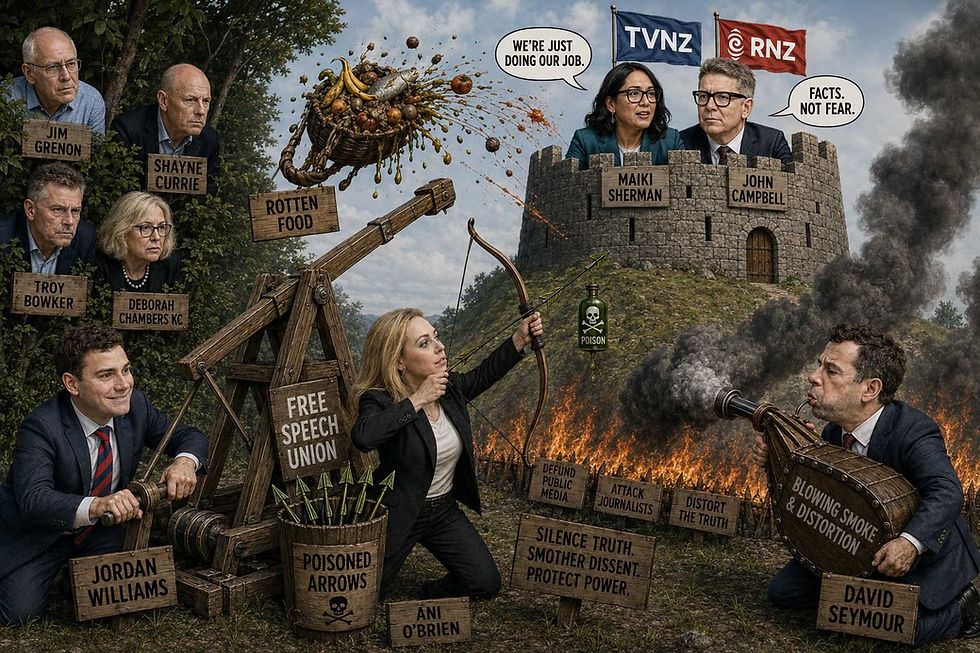
We’ve seen this muppet show before


Matthew Hooton’s move to the editor’s chair at The Post follows a script already written in Washington — and it lands at the moment New Zealand’s newsrooms have never been cheaper to capture.
On Monday, Stuff announced that Matthew Hooton — former Young Nat, press secretary in the Bolger government, strategist for National under Don Brash, briefly an adviser when Todd Muller toppled Simon Bridges, sometime ACT adviser and adviser to Auckland mayor Wayne Brown, and founder of the lobbying firm Exceltium — would become editor-in-chief of The Post and the Sunday Star-Times. He has never trained or worked as a journalist.
The reaction, reported identically by the Herald’s Media Insider and by RNZ’s Colin Peacock, was three words: “What the f***?”
Strip away the shock and a more familiar shape appears. We have seen this episode before. We are simply watching it again, in our own accent, and a little behind the American broadcast.
Contents
A bold appointment
The facts are not in dispute; only their meaning is.
Stuff owner Sinead Boucher shoulder-tapped Hooton through a mutual friend a month ago, telling Stuff’s Lloyd Burr that “few people understand power in New Zealand as well as Matthew does.”
Hooton said he hoped the country’s powerful institutions would be “a little unsettled” by the move.
The Post’s existing business, economics and political editor, Luke Malpass — the masthead’s most prominent centre-right voice — slides sideways into a new associate editor role.
Hooton himself conceded the obvious: “Some may see this as a bold appointment.”
The backdrop is not health but distress.
Stuff was sold to Boucher in 2020 for a single dollar.
The Post’s presses are leaving Petone after more than thirty-five years — businessman and outspoken Stuff critic Troy Bowker bought the building — and the paper will soon be printed in the South Island and ferried across Cook Strait, a crossing notorious for swallowing schedules.
Bowker’s own verdict on the new editor was that he would need luck selling yesterday’s news off an unreliable ferry. The editor of a Wellington paper, meanwhile, will be based in Auckland.
When a masthead in that condition reaches past every working journalist in the country for a political strategist with no newsroom experience, it is worth asking whether this is editorial vision or a Hail Mary.
The precedent that comes to mind is not flattering.
Cameron Slater was installed at the top of the 106-year-old Truth in its dying days. In a fight for its life, the title did not survive the experiment.

A bold appointment and a desperate one can look identical from the outside.
A newspaper that has run out of money does not hire its way back to relevance; it gambles.
The American script
To see where this leads, watch CBS.
In 2024 Donald Trump sued CBS over a 60 Minutes segment. Paramount, which needed federal sign-off for its merger with David Ellison’s Skydance, settled for about US$16 million. The merger then cleared the Federal Communications Commission, chaired by Trump appointee Brendan Carr, after Skydance promised the regulator greater “viewpoint diversity” at CBS.
With the deal done, Paramount bought the opinion site The Free Press for a reported US$150 million and installed its founder, Bari Weiss — an opinion writer with no broadcast experience — as editor-in-chief of CBS News. Weiss has since removed the executive producer of 60 Minutes and two of its correspondents, and Ellison has appointed a former conservative think-tank head as an in-house ombudsman to field complaints about the network.
The pattern did not stop at CBS.
Three days after Stephen Colbert criticised the 60 Minutes settlement on air, his Late Show was cancelled; the network called it a purely financial decision.
When Jimmy Kimmel was pulled after Carr publicly leaned on the networks, the affiliate groups that dropped him — Nexstar and Sinclair — were themselves carrying deals that needed Carr’s FCC. Carr’s promise to the industry was four words: “we’re not done yet.”
Read as a sequence, the logic is plain.
A newsroom known for long-form, adversarial journalism is placed under a political operative at precisely the moment its corporate parent needs a regulator’s blessing.
The journalism most exposed is the kind that takes months and annoys powerful people.
The Post is not 60 Minutes, but it employs Andrea Vance and a Wellington bench of reporters who do exactly that kind of work.
The American version took a lawsuit, a settlement and a merger. Ours may only have taken a phone call from a mutual friend.
The billionaires’ decade
Behind the appointments sit the owners.
The past decade has been an education in what happens when newsrooms become the property of very rich men with views.
Jeff Bezos bought The Washington Post in 2013; in 2024 he spiked the paper’s editorial endorsement of Kamala Harris, and has since reoriented its opinion pages around “personal liberties and free markets,” prompting a wave of departures.
Elon Musk bought Twitter outright and remade it as X in his own image.
Peter Thiel — a ‘naturalised’ New Zealand citizen — bankrolled the litigation that bankrupted Gawker, demonstrating that you need not buy a newsroom to close one.
New Zealand is not exempt; it is just smaller and cheaper.
As I set out in How to takeover TVNZ and RNZ with pocket change, the Canadian-born investor Jim Grenon moved into NZME in 2025 and became its largest shareholder, with Steven Joyce — a former National finance minister and the party’s five-time campaign chair — installed as chair.
When The Australian floated the country’s wealthiest man, Zuru’s Nick Mowbray, as a possible NZME buyer, he denied it and called the company “one of the better and fairer ones.” But Mowbray is also a substantial donor to both National and ACT, which is the more relevant fact.
Ownership is the quiet lever; editorship is merely the visible one.
The repeater
Which brings us to the man himself, and a question worth asking aloud: whose script is he reading?
I have said before that if the National Party had an original idea it would be lonely.
Shortly after Sir Edmund Hillary’s documentary A View From the Top was released, Jim Bolger’s autobiography bore the same name.
Hooton has been close to that party since his Young Nat days and his time in Bolger’s office, and in three decades of commentary I have rarely heard him risk an opinion that one of his colleagues had not already floated. His predictions have a habit of arriving as his allies’ wishes and then, conveniently, coming true.
Cameron Slater calls people like Hooton a “repeater”: a sounding board who conditions an audience to a message that originated elsewhere.
That is the uncomfortable resonance with CBS. Bari Weiss did not invent the politics she brought to the network; she carried them in.
The question for The Post is the same.
If Hooton is, by temperament and training, a man who transmits other people’s lines with conviction, the only thing that changes when he takes the chair is the size of the megaphone and the identity of whoever is speaking into the other end of it.
Aaron Sorkin’s The Newsroom warned about this in 2011 — a cable news division bent slowly to commercial and proprietorial pressure until the journalism became theatre.
John Oliver and the late-night hosts have spent the past year narrating the American version in real time, which is its own grim comedy: the watchdogs reduced to a chorus, describing the siege rather than resisting it.
We are not waiting for the ending. We are watching it arrive, one appointment at a time.
The conflict question
Hooton insists he is, in his own words from a 2019 interview the Spinoff chose to republish on the day of his appointment, “completely squeaky clean.”
He has built a career advising clients whose identities are, for the most part, not public. Exceltium’s website lists the engagements he is, by his own account, proud of.
It does not list all of them, and it has not always listed the ACT Party, which he has acknowledged as a client.
He advised Wayne Brown’s run for the Auckland mayoralty.
He has described his own model frankly: when a minister stonewalls a client, the firm takes the issue “wider” — which is to say, to the media.
The reasonable worry is not that a commentator holds opinions. It is that the same person has, for years, been paid to shape outcomes for clients while publicly praising or savaging the politicians who could deliver them — and now controls what a newsroom investigates and what it leaves alone.
In 2018 he withdrew from his RNZ slot only after it emerged he had backed a National leadership bid without declaring his own hand in it.
He says he is one of the few commentators who proactively discloses. Both things can be true; neither settles the question.
The test of an editor’s conflicts is not what he discloses, but what never gets commissioned.
Defining the battlefield
Predictably, the appointment’s defenders moved quickly to choose the ground on which it will be fought.
The mainstream press still files Ani O’Brien as a “political commentator” or a “Substack writer.” Her day job, on her own LinkedIn and the Companies Office record, is General Manager of The Campaign Company — Jordan Williams’ public-affairs firm, whose stock-in-trade is the manufacture of grassroots-looking opinion for clients that have included Hobson’s Pledge, Groundswell and the Taxpayers’ Union.
She also sits, with Williams, on the council of the Free Speech Union.
As I set out when they came for Maiki Sherman, this is not a bystander offering a hot take.
Her post performed bafflement — she had, she wrote, no idea whether Hooton would be brilliant, terrible or somewhere in between — and then did the real work: recasting the objection to him as snobbery about credentials, waving away the “right-wing takeover” reading by pointing at Boucher, and reframing the whole affair as a welcome dose of “diversity of thought.”
That is battlefield-definition.
The objection to Hooton was never that he lacks a journalism degree; it is that he is a career partisan operative and lobbyist whose client list is largely hidden.
And a General Manager of a public-affairs firm does not produce six hundred words of polished framing within the hour by accident. It reads less like a reaction than a prepared line.
The irony she trusts the reader not to notice is that she is the living specimen of the conflict she is dismissing.
This is the operative who, weeks earlier, authored the Substack post that — a year after the events it described — landed just as Maiki Sherman, the state broadcaster’s wahine Maori political editor, was at her most vulnerable, and which the Free Speech Union then republished in full on its own masthead.
Massey University’s Professor Mohan Dutta called that post not journalism but “a strategic communication artefact.”
An undisclosed-client operative who helped take out a journalist is now defending the installation of an undisclosed-client operative over a newsroom.
That is not a coincidence of opinion; it is the operator class closing ranks around one of its own.
And listen to the vocabulary.
“Diversity of thought” is a cousin of the “viewpoint diversity” Skydance fed the FCC to land Bari Weiss the CBS chair — the line that sold an operative over an American newsroom, now selling one over a New Zealand one.
The repeater again; only this time it is the defence reading from the imported script.
In fairness to the sceptics of the sceptics, RNZ did overstate its case.
As Barrie Saunders pointed out, and as Gavin Ellis told RNZ, Hooton is not the first non-journalist to edit a major New Zealand paper — Sir Leslie Munro went from the law to the editor’s chair at the Herald.
The precedent exists.
What is new is the combination: not a lawyer or a businessman, but a working political strategist and lobbyist, taking the masthead while the sector around him waits to see who will own it.
When the people defining the battlefield make their living manufacturing the grass it is fought on, the choice of ground is not innocent.
The merger question
So ask the question the credentials debate is designed to avoid: what is this appointment for?
The Commerce Commission, upheld by the Court of Appeal, blocked the NZME–Fairfax merger on the ground that one company should not own that much of the country’s news.
That decision is the wall every subsequent consolidation has had to climb.
The Herald’s own Media Insider has already tied Hooton’s arrival to “questions about The Post’s future ownership” — and asked, pointedly, whether the Prime Minister should be more nervous about it than the Opposition.
Set that beside the siege I described last fortnight: isolate the newsrooms by starving them, infiltrate the governance by controlling the appointments, then integrate the wreckage by selling it to a sympathetic buyer as a rescue.
An editor who understands power, is trusted across the centre-right coalition, and owes his chair to the owner is exactly the kind of appointment that warms the ground for the next restructuring.
None of that requires a conspiracy.
It only requires that the innocent explanations, lined up in order, keep pointing the same way.
A blocked merger is not a closed door. It is a door waiting for someone the government trusts to hold it open.
The case for the defence
Fairness demands the other reading, and it is not weak.
The industry is in real trouble, and the strongest argument for the appointment does not depend on who is making it.
Newsrooms have narrowed, trust has fallen, and doing more of the same has not arrested the decline.
Boucher is no one’s idea of a right-wing entryist; she may simply have concluded that a paper fighting for survival needs an editor who reads the country’s power structures better than anyone else available.
Hooton’s own framing of the job is unimpeachable on paper: editors, he said, must defend journalists, take risks, and publish work powerful people dislike.
Simon Bridges, of all people, called the appointment “outstanding”. The commentator Philip Crump called it astute. David Farrar called it smart but risky.
And Hooton’s record as a critic is not partisan in the lazy sense — he attacked John Key over the SIS affair and over the ponytail, and he has not spared Christopher Luxon.
It is also true, as he insists, that thirteen years of consulting without a disqualifying scandal is some evidence of discipline. The proof, as Boucher put it, will be in the pudding.
The honest position is that this could be a revival or a capture — and that the people assuring us it is the former have the most to gain if we look away.
Watching it in slow motion
There is one last cost, and it is Hooton’s alone to carry.
For thirty years he has operated where he is most comfortable: behind the scenes, managing his own profile through commentary he controls.
The editor’s chair ends that.
He is now a public figure in the fullest sense, and the scrutiny he spent a career directing at others will turn on him — as it must on anyone who edits a national masthead.
He once called a television journalist’s reporting “corruption,” then shrugged that it was just a phrase that rated well.
He will not have that latitude now.
Within minutes of Hooton’s appointment, this screenshot was making the rounds on social media:

While other moderators quickly deleted the image, it remains on The Spinoff and on private profiles.
Does The Post really have the resources to be playing Whack-a-Mole with Hooton’s past? How would their journalists feel if their impartiality and integrity was questioned due to being compared with the past commentary and actions of their editor?
An editor who becomes the story is an editor who cannot do the job, and a newsroom whose leader is permanently in the headlines becomes fodder for rivals — not least the Herald’s Shayne Currie, who has already made the appointment a running item.
Was any of this avoidable, or was it always going to end here?
The American season is most of the way through its run: a lawsuit, a settlement, a merger, an operative in the chair, a long-form newsroom quietly reshaped.
We are earlier in our own broadcast, with the dubious advantage of having seen theirs.
The danger is not that we cannot tell what is happening. It is that we have watched so much of it, for so long, that we have started to treat it as weather.
We have seen this episode before. The only open question is whether we change the channel, or sit through the ending we already know.