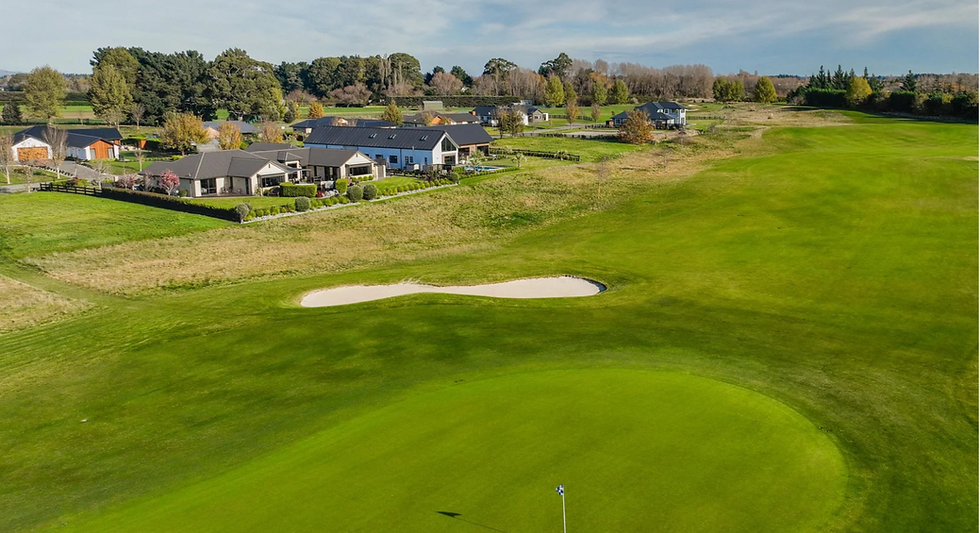
Pegasus Brief — The two rejected bids


Two groups bid to keep Pegasus operating as a golf course. One had local skin in the game — properties around the course and every commercial reason to protect the amenity. The other had twenty years of golf-industry expertise and was prepared to be open within weeks. The receivers preferred the bid that erased the course. The most arresting question of the last seventy-two hours is not whether the tender was fair. It is why nobody, at any point, put the two bids together.
Last 24 hours
The Vining family — New Zealand’s largest golf-equipment distributor and former owner-operators of a Palmerston North golf complex for around twenty years — has published an open letter (see below) confirming they tendered for Pegasus, were prepared to have play running again within weeks, and allege that "after the official deadline for submissions had passed and offers had already been lodged, parties who had submitted bids were reportedly approached and asked to reconsider or revise their offers and terms." They pose five questions about the process. Chris Lynch Media covered the letter under the headline "Golf industry family says Pegasus golf course sale process was not fair."
Waimakariri MP and Mental Health Minister Matt Doocey opposed the Wolfbrook proposal in a Wednesday Facebook statement, recording that "my understanding there was local and national consortium bids submitted that would have invested into the golf course to build the facilities needed to make it an international golfing destination." He pointed to Ravenswood and Gressons Road as evidence that housing demand is being met without sacrificing Pegasus. He has not yet engaged with the Wolfbrook donation, the Fast-track Approvals Act, or the wider structural failure across the sector — covered in yesterday’s klaut.media follow-up.
Mayor Dan Gordon, in a Waimakariri District Council statement on 17 May, confirmed that "Council only heard about a definite sale at the same time as everyone did on Friday" and that "to my understanding there have been no information requests and/or approaches to the Council about any rezoning." He has sought a meeting with Wolfbrook and said he hopes the new owner "honours the vision Bob Robertson had for this area."
Environment Canterbury Chair Deon Swiggs had to publicly intervene to get the irrigation pumps switched back on after residents raised concerns about birdlife, tuna and eels: "the pumps are now back on and the ponds/lakes are filling again." ECan confirms the existing stormwater and irrigation consents remain active and that Wolfbrook is bound by their obligations pending formal transfer.
The Pegasus Residents Group Incorporated has moved the 2 June community meeting to Pegasus Bay School at 7pm to accommodate expected numbers. Questions can be submitted in advance through the PRGI website.
Why didn’t anyone put the two bids together?
That is the question this brief exists to ask. It is also the question the rest of the story now turns on.
Two parties bid to keep Pegasus operating as a golf course.
One brought local skin in the game — substantial existing landholdings around the course, every commercial reason to protect the amenity that priced their adjoining properties at a premium, and the kind of community alignment that turns a developer into a neighbour. That bidder is not being named in this brief while their position is confirmed and while they consider whether to make a public statement of their own.
The other was the Vining family — the largest golf-equipment distributor in the country, with two decades of running a golf complex profitably, and the operational discipline to have play running again within weeks of settlement.
A combined bid would have offered the residents and the receivers something neither bidder alone could.
Capital underwritten by adjoining-landowner skin in the game, paired with the operational expertise to run the course profitably as a course.
It is the structural answer to the question Doocey himself put on the public record three days ago — the kind of bid that would have invested in Pegasus to build it into an international golfing destination.
It is also, almost exactly, the model Clearwater’s members executed in 2009 when they bought their course out for $3 million to decouple it from the developer who built it.
Clearwater’s greens are still being watered today. The same developer’s holding company is in liquidation. The structure protected the asset.
It is the only reason Clearwater survives the corporate failure that has just consumed Pegasus.
That is what makes the receivers’ preference so structurally telling.
The narrow logic of a mortgagee sale is well understood: maximise the return to secured creditors, who are owed more than six million dollars at Pegasus. The bids that wanted to operate the course as a course were valued, in that calculation, by the secured creditors’ yield alone. The bid from a residential developer with no golf-operating history was valued the same way — and won.
The receivers did exactly what the legal architecture asked them to do.
The legal architecture asked the wrong question.
It asked which bid pays the most. It did not ask which bid preserves the consent the township was built on, the amenity its residents paid premiums for, the cultural landscape between Kaiapoi Pā and Tūtaepatu Lagoon, the ratepayer’s long-term position, or the master-planned vision Bob Robertson signed his name to.
None of those are the receivers’ problem. All of them are now everyone else’s.
The Vinings have asked five questions of the process. The Mayor has already answered one of them — the council was not informed in advance.
The other four — how the tender was conducted, whether all bidders were treated equally, why preservation was not prioritised, and whether redevelopment outcomes were effectively predetermined — sit with the appointed liquidators, Tony Maginness and Jared Booth of Baker Tilly Staples Rodway. Their reputation is now part of this story. They can answer, or they can let the silence speak.
Either way, the more useful question is the one the synergy framing surfaces: this opportunity was always there, sitting in plain view, and nobody put it together while it could still have been put together cheaply.
The residents now have to do, in negotiation under pressure, what could have been done six months ago by two bidders comparing notes over a coffee.
Watch list
Tuesday 2 June, 7pm, Pegasus Bay School — the residents’ community meeting. Ten days away.
Mayor Gordon’s meeting with Wolfbrook — sought publicly on 17 May, no date yet confirmed. The outcome will determine the council’s formal position before the residents meet.
A response from Baker Tilly Staples Rodway to the Vinings’ tender-process allegation. The longer the silence, the more weight the allegation carries.
A response from Wolfbrook CEO Guy Randall to the public emergence of two named alternative bidders. The "no viable alternative" framing has lost its load-bearing premise.
Whether Pegasus appears on a forthcoming Fast-track Approvals Act list. The Minister for Infrastructure’s office told the Herald this month it was "not aware of any progress on the golf site through Fast-track." That position is the load-bearing assurance and the one most worth watching.
Thank you everyone for reading, sharing, and reaching out. I didn't anticipate the scale of the issue and the stakes. Tips, corrections, and additions to grant@klaut.media.