Who really wins when councils scrap minimum parking rules?


Central and local government stripped car parking requirements from new developments to fix the housing crisis. It has made land more valuable, planning weaker, and streets unliveable — for residents and for the businesses whose customers can no longer find a park.
Drive through almost any new subdivision or infill development in the country and the same scene repeats: cars mounted on front lawns, backed onto blind corners, and jammed nose-to-tail down streets barely wide enough for one lane of traffic. This is not an accident of bad driving. It is the designed outcome of a policy that stripped councils of the power to require a single off-street car park from a new development, residential or commercial, other than a mobility park for accessible parking.
The National Policy Statement on Urban Development told councils from 2020 that they could no longer set minimum car parking rate requirements in their district plans. The sales pitch was fewer cars, more walking, and cheaper housing.
As I've set out before, shrinking the section is the same trick planners have used for decades to lift the price of land by the square metre.
The real question is who actually captured the saving from the removed parking requirement — and whether the policy was ever really about walking at all.
Contents
The rule that changed
Policy 11 of the NPS-UD directed every tier 1, 2 and 3 council — effectively every urban area with more than 10,000 people — to remove minimum car parking requirements from their district plans by 20 February 2022.
Councils, however, could still allow developers to provide parking voluntarily. They could no longer make them.
Gee, what could possibly go wrong?
The parking change did not arrive alone. A year later, the Resource Management (Enabling Housing Supply and Other Matters) Amendment Act 2021 forced Auckland, Hamilton, Tauranga, Wellington and Christchurch to allow up to three homes of three storeys on most residential sites without resource consent.
Smaller lots, no parking minimums, and a fast-tracked consenting path arrived as one bundled reform — sold as a housing supply fix, applied uniformly to a country where owning a car is still the norm, not the exception.
The numbers are not in dispute
The 2023 Census recorded that just 6.3 percent of New Zealand households had no motor vehicle available to them.
The remaining 93.7 percent had at least one — and nearly 21 percent had three or more. The policy assumed households would shift to walking, cycling and public transport once car parks stopped being guaranteed.
The census says most households simply kept the car and lost the park.
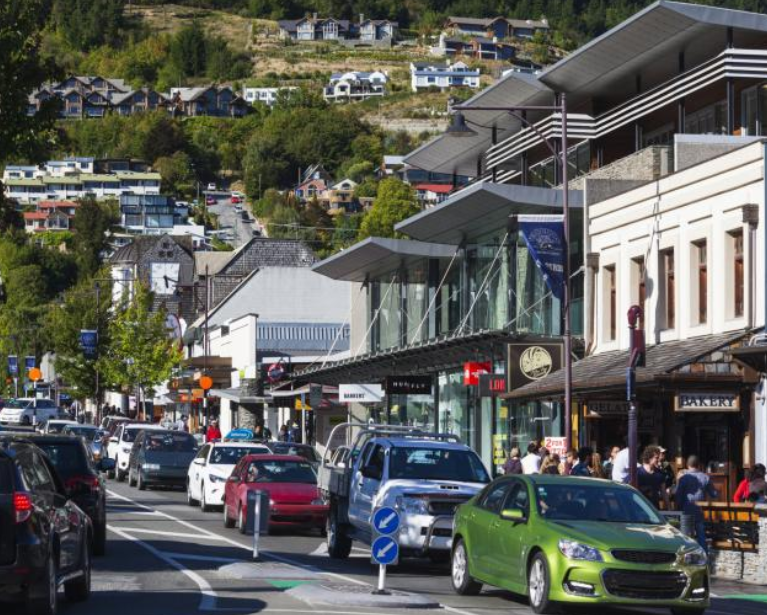
Queenstown's uncounted vehicles

I've set out the mechanics of Queenstown's building boom elsewhere — greenfield homes generating far more daily vehicle movements than the roads were designed for, and streets used as overflow storage for construction traffic.
The district's own planners have made the underlying land economics explicit. Queenstown Lakes District Council's Urban Intensification Variation reduced minimum lot sizes and minimum lot dimensions specifically to enable more lots per site, while cutting the High Density Residential boundary setback from two metres to 1.5.
Smaller sections, tighter margins between buildings, and no requirement to provide a car park anywhere on them.
The squeeze falls hardest on the shared housing that keeps Queenstown's tourism economy staffed. When the council banned overnight parking on Park Street and Lake Esplanade to clear freedom campers, workers in older housing stock with driveways built for one car — not the two or three a share-house now runs — were displaced onto streets half a kilometre from home. One resident told the Lakes Weekly Bulletin that the rules take no account of how many people, and how many cars, a single Queenstown house now holds.
The same arithmetic runs through rural land.
As I've argued elsewhere, once a hectare can be subdivided into lifestyle blocks it is priced as residential land, not agricultural land, and no farmer can compete with a developer at that value.
Cutting minimum lot sizes and parking requirements at the urban fringe is the same lever pulled twice — squeezing more yield out of the same title, whether the paddock in question is zoned rural or residential.
The commercial spillover
This is not only a residential problem.
In Christchurch's Ely Street, apartment blocks tripled the number of residences on the street without adding a single extra car park. Christchurch Central ward councillor Deon Swiggs told The Press that the city's post-earthquake density blueprint failed to plan for the off-street parking that intensification would require. Residents were left fighting for kerb space on a narrow, T-shaped street never built for the traffic now generated on it.
The same dynamic plays out around big-box retail.
Where developments are approved with parking calculated only against the number of "units" rather than the number of workers and customers who actually use the site, staff and delivery vehicles spill onto the nearest residential streets, leaving genuine customers circling for a park and, as Stuff reported of one Christchurch retail strip, walking a considerable distance just to reach the shop.
But what is overlooked is that many big block retailers, with large onsite parking, tell their staff to park on nearby residential streets so to maximise parking for their customers. Effectively, parks are prioritised for customers over staff and residents.
It is the mirror image of what I've documented happening on cycleways: whether the parking is removed for a bike lane or simply never required of a developer in the first place, the missing capacity ends up displaced onto whichever street has not yet been re-engineered.
Auckland's mayor concedes the point
Auckland mayor Wayne Brown has acknowledged the problem publicly, but Housing Minister Chris Bishop is deluded.
Brown told the New Zealand Herald that removing minimum car parking requirements was causing visible problems in narrow-street suburbs such as Hobsonville and Tamaki, and in areas where Kainga Ora has been building at density.
Bishop rejected the criticism, arguing the newer intensification rules replaced the earlier three-storey standard and that nothing stops a developer providing parking if they choose to.
Developers, notably, are not always choosing to.
Simplicity Living managing director Shane Brealey told the same paper that three-storey infill built with no parking at all was clogging local streets, and that many of the units built under the earlier rules had been sold largely to investors rather than the families the policy was meant to house.
Wellington's version of the same fight
In Lower Hutt's Taita, a wave of apartment and townhouse blocks has gone up without off-street parking, pushing residents into open conflict over the kerb outside their own homes.
One Milne Crescent resident told the New Zealand Herald that neighbours had left notes on windscreens and put out road cones to keep newcomers from parking near their driveways. A resource consent for one nearby development on Johnston Grove concluded the effect of new residents parking on the street would be "less than minor" — the same finding, repeated street by street, that leaves councils able to sign off density without ever weighing the cumulative effect on the road outside.
Hutt City Council's own Plan Change 39 halved the parking requirement for new residential dwellings from generally two spaces per unit to one, well before the government's own national direction forced its hand — proof that the appetite to strip parking requirements from developers was a council-level choice as much as a Wellington-imposed one.
The Hutt's Member of Parliament, Housing Minister Chris Bishop, saw a preview of the problem but applied it to the rest of the country.
Who actually profits
Land is priced by the lot, not the square metre.
Halve the minimum lot size, or remove the requirement to set aside space for a car park and a turning area, and the same title yields more sections, more units, or a bigger building footprint — without the developer paying a cent more for the underlying land.
The saving is captured at the point of sale. It is not passed on as a discount to the family renting a three-bedroom townhouse with nowhere to park the second car.
I've made the broader version of this argument before: land is only worth what it is permitted to be used for, and every relaxation of a planning standard shows up first in the sale price, not the rent.
Brealey's own admission — that recent infill stock was "largely sold to investors" — is the tell.
A planning change marketed as a fix for first-home buyers has, on the account of the industry's own developers, delivered a smaller, cheaper-to-build product at an unchanged or higher price per square metre, while the cost of accommodating the residents' cars was quietly transferred from the developer's site plan to the ratepayer-funded street outside it.
It is the same pattern I've traced in the consenting system generally: developers price the planning process into the section before a single house is built, and every rule a council removes from its own plan is a cost that simply moves somewhere else — in this case, onto the street.
The apartment got smaller, the driveway disappeared, and the narrower street outside became the new car park — developers simply moved the cost from their own ledger onto yours.