


Why did the Herald sit on the ambassadors’ op-ed?

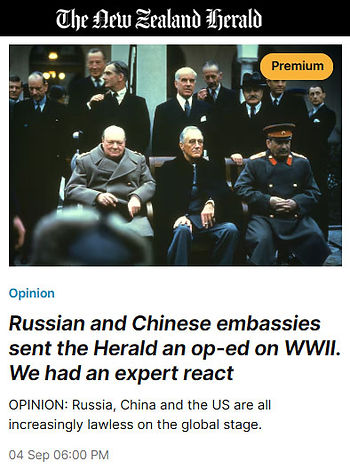
Moscow and Beijing wanted a commemoration. They got a quarantine.
Japan signed its surrender aboard the USS Missouri on 2 September 1945. A New Zealand representative was on deck.
China marks the victory a day later, on 3 September. So does Russia, which shifted its commemoration to the same date in 2023 — over Japanese protests.
So when the Chinese and Russian ambassadors, Wang Xiaolong and Stanislav Krans, jointly sent the NZ Herald an op-ed marking the 81st anniversary, the date was the point.
The Herald ran it on 4 September. At 6pm.
After the surrender anniversary. After Beijing’s Victory Day. After Moscow’s.
That was not an accident. That was the strategy.
Look at the treatment. The byline reads “Opinion by NZ Herald” — the ambassadors do not even get their names at the top. The headline frames their piece as a specimen: the embassies “sent the Herald an op-ed”, and “we had Professor Alexander Gillespie react to it”.
Not a contribution. An exhibit.
The piece is then paired, in the same article, with a rebuttal from Gillespie, an international law specialist at Waikato. The whole package sits behind the Premium paywall.
This is textbook inoculation. Publish the propaganda — but strip its timing, deny its authors a clean byline, wrap it in a warning label, and attach the antidote before the reader can catch anything.
Newspapers hate being couriers. Embassies writing joint op-eds are not contributors; they are states running influence operations through the letters page. The Herald clearly decided it would not carry the message on Beijing and Moscow’s schedule.
Fair enough. But note what the delay conceded: the piece was newsworthy enough to run, just not useful enough to run on time.
What about the op-ed itself?
Parts of it are simply true. The Soviet Union and China bore staggering losses — tens of millions dead, most of them civilians. The Nuremberg and Tokyo judgments anchor modern international law. Nobody serious disputes either point.
But the piece is a masterclass in selective memory. The Molotov-Ribbentrop Pact — under which Stalin carved up Poland with Hitler and supplied Germany until June 1941 — goes unmentioned. Gillespie lands this politely: the “duplicity of Stalin’s former Soviet Union at the beginning of the war”.
The op-ed’s sharpest material is aimed at Japan — Yasukuni Shrine visits, “whitewashing”, a drift back to militarism. It is the one section with a genuine grievance behind it. It is also the cover for everything else.
And the ambassadors overreach with their innuendo that today’s New Zealanders have forgotten the war. Gillespie’s answer is the best line in the package: stand at any Anzac Day service on 25 April and say that.
Then comes the wedge. The ambassadors lament that New Zealand was not among the 119 nations that backed Russia’s annual UN resolution against “glorification of Nazism” last year.
They omit why. Fifty-one countries voted no. New Zealand’s stated reason: Russia uses the resolution as a vehicle for the false narrative that its invasion of Ukraine is “denazification”.
A country waging an aggressive war asked us to sign its permission slip. Wellington declined. Good.
Gillespie’s rebuttal is measured — arguably too measured. He concedes the suffering, praises the ambassadors’ UN Charter quotes, then asks the questions that matter.
Why are Russia and China — and, he notes fairly, the United States — not members of the International Criminal Court that upholds the very Nuremberg principles they invoke?
Why will China not accept the 2016 South China Sea arbitration ruling?
Why does Russia ignore the International Court of Justice’s binding order to halt military operations in Ukraine?
The ambassadors’ answer is silence, because there is not one.
Their op-ed asks New Zealand to remember 1945. Gillespie asks them to explain 2026.
The deeper story is the Herald’s method. When a foreign state pitches propaganda, the paper quarantines it: late, framed, rebutted, paywalled.
Apply that standard consistently — to the domestic lobby groups whose op-eds run clean, on time, under friendly bylines — and New Zealand journalism would be transformed.
The embassies came to defend history. They left having demonstrated why nobody trusts them with it.


