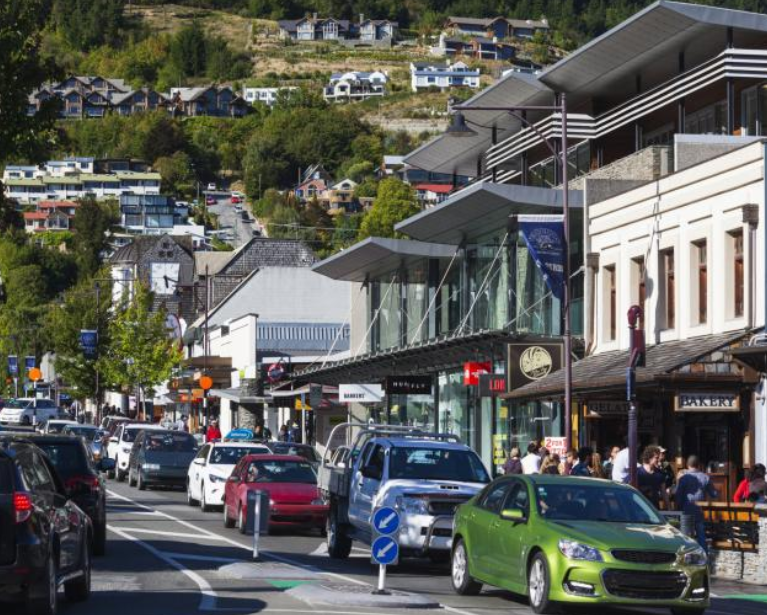
Why is Queenstown asking the public to fix a mess it approved?


A resort town let ribbon development swallow its only roads, blacklisted the journalist who exposed its wastewater failures, and is now asking the public for ideas on how to fix what its own decisions caused.
Queenstown-Lakes mayor John Glover wants ideas. He has set up a mayoral taskforce on congestion and is asking residents to help solve a network that has, in his own words, reached a tipping point — a drive that once took ten minutes can now take ninety.
That request for help is the tell.
Queenstown's traffic crisis was not a surprise that arrived overnight. It is the compounding result of a development model the district council itself approved, block by block, consent by consent, for two decades.
The real question is not what ideas the public can offer now. It is why the council needed to ask at all.
Contents
The tipping point was foreseeable
The scale of the problem is no longer disputed by anyone at the council table.
The government's own transport agency has just spent $250 million on the 'Queenstown Package', a four-year rebuild of the district's busiest intersection at Frankton, and even that project won't double-lane the approach to the Five Mile roundabout or the Lower Shotover Bridge — there is, as NZTA's own regional design manager admits, no funding currently allocated for it.
Mayor Glover says he would "absolutely" like that stretch double-laned while the diggers are already there. It isn't happening.
Further south, The Press reports that local government has produced more than 2,000 pages on the Frankton Road problem alone, while two competing private consortiums now pitch a cable car and a suspended pod network as the fix officialdom couldn't deliver.
When private capital is drawing up parallel transport plans because the council's own business case is still debating whether to investigate a gondola, the council has lost the initiative on its own patch.
Ribbon development along the only road
None of this was unforeseeable.
Queenstown Lakes District Council has spent years approving housing along, and immediately beside, the same handful of state highway corridors that were never built to carry it.
Reporting on the Ladies Mile subdivisions shows the council's own numbers: Lake Hayes Estate, Shotover Country and the Queenstown Country Club already held more homes between them than historic Arrowtown, and the council's masterplan signalled another 1,100 dwellings on the northern side of the highway on top of that — while projecting 10,050 new homes district-wide over thirty years, all needing to move along the same constrained network.
More recently, Arrowtown residents rallied against a fast-track application for 1,210 houses at Ridgeburn — a site the newly formed Queenstown Smart Growth Initiative points out sits roughly six kilometres beyond land the council's own spatial plan had already identified as well-located and serviced.
The mayor himself has said the fast-track process lets developers sidestep years of planning work and leaves councils and communities to pick up the bill. That is not a complaint about central government process. It is an admission that the district's own spatial plan is being routinely outrun by consenting decisions the council does not control and, in cases like Ladies Mile, decisions it did.
The number one reason people don't like coming to Queenstown is the traffic — and once the ribbon development is built, there's no coming back.
A bridge that fed the problem it was meant to solve
The clearest case study sits on the Frankton Arm.
The Kawarau Falls Bridge replaced a single-lane, 90-year-old crossing with a modern two-lane structure, built in part because commercial growth on Frankton Flats had already outstripped the old bridge's capacity — and NZTA quietly laid new bulk water and wastewater mains underneath it specifically to future-proof land development south of Frankton.
Development of Hanley's Farm, a 561-hectare satellite suburb immediately south of the bridge, began the same year construction finished. The bridge built to relieve congestion became the on-ramp for the subdivision that recreated it.
This is the pattern I've watched play out for years:
Announce a piece of infrastructure as the cure,
Then approve the greenfield development that consumes its capacity before the paint dries.
It happened again with the Melbourne and Henry Streets upgrade, pitched as a CBD bypass at a cost that eventually reached $130 million — more than double the Crown's original $50 million commitment — for a stretch of road only around a kilometre long.
Deputy mayor Quentin Smith has separately warned that a pause on new housing consents should be considered until the district has a workable plan for its sewage, after the town's overloaded treatment plant drew Otago Regional Council enforcement action in the Environment Court.
Roads and wastewater are the same story: infrastructure arrives late, undersized, and already spoken for.
Non-notified, and out of sight
Much of this has been possible because so many of the decisions never reached public view.
Ministry for the Environment resource consent data show Queenstown Lakes has one of the highest rates in the country of non-complying consents processed on a non-notified basis — decisions made behind closed doors, without the public submission and hearing process a non-complying activity would ordinarily attract.
The same data show a striking number of comparable non-complying applications that were declined once independent commissioners actually heard them, publicly.
That gap raises an obvious question: how many of the applications waved through on a non-notified basis would have failed the same test in the open?
A recent case makes the pattern concrete.
I am the former hearings commissioner who blew the whistle on an over-height accessory building at Speargrass Flat, built into a landscaping bund so that, as he put it, council had "effectively" consented a two-storey building on top of structures designed to hide single-storey homes.
The subdivision's own original developer, architect Fred van Brandenburg, said the result made "a nonsense" of the subdivision's original intent — a rare instance of a developer and a former commissioner agreeing that a non-notified consent had defeated the very planning conditions it was meant to honour.
Multiply that dynamic across a decade of non-notified approvals and the traffic numbers stop looking like bad luck.
The bill the developers were meant to pay
Every one of those new subdivisions triggers development contributions under the council's own policy — charges levied specifically to fund the transport, water and reserve capacity that growth demands.
On paper, satellite suburbs are supposed to be self-funding. In practice, the ratepayer has been left carrying cost overruns on the roads that were meant to serve those suburbs, while a 13.5 percent rates increase landed in the same annual plan that followed a 15.6 percent rise the year before.
If financial contributions from new development had been directed at the roading network rather than absorbed elsewhere, much of today's bottleneck would already be built out.
When the council was the story it wouldn't cover
Traffic is the most visible symptom of a council that has let growth outrun capacity. It is not the only one.
QLDC has been pumping partially treated effluent into the Shotover and Kawarau rivers under emergency powers for more than a year, after the wastewater plant's disposal field failed, and in March this year a monitoring reading near the discharge point hit 2,100 colony-forming units of E. coli — eight times the council's own consented limit and almost four times the level the Ministry for the Environment deems unsafe for swimming.
QLDC's response to RNZ was that the site wasn't a common bathing spot and that whatever caused the spike was probably gone by the time the result came back.
No warning signage went up.
Separately, Otago Regional Council has taken the district council to the Environment Court over repeated breaches at the same plant.
The reporter who had been covering this story for two years, Crux Media founder Peter Newport, was blacklisted by QLDC's communications team in late April this year — barred from media stand-ups and press benches at council meetings — on the stated grounds that the council no longer had confidence he could "function as a news entity operating under accepted professional standards."
Three days later, RNZ ran the E. coli story that confirmed what Newport, a one-man Substack operation, had been reporting for months.
The sequence is the story: the reward for being proven right was being shut out of the room.
The council's stated basis for the blacklist was that Crux had withdrawn from the New Zealand Media Council — a voluntary industry body with no statutory power to define who is or isn't a journalist. QLDC does not apply that test to any other outlet it deals with.
None of that reads as an isolated personality clash. It reads as a ratepayer-funded communications operation — with a Governance, Engagement and Communications Manager, a dedicated media spokesperson and a corporate services general manager, funded out of a rates take that rose 13.5 percent in the 2025–26 Annual Plan on top of 15.6 percent the year before — deciding, in effect, who the district's residents are allowed to hear from about its own performance.
When the same council is separately telling ratepayers not to worry about ribbon development outrunning its infrastructure, that combination is worth naming plainly: a council that is not simply behind on capacity, but actively managing the story about being behind on capacity.
One rule for money, another for everyone else
The Speargrass Flat case in the earlier section shows how an ordinary non-notified consent can quietly defeat the planning conditions it was meant to honour.
Compare that with what happened at Dalefield in December 2022, when Empire State Realty Trust boss Tony Malkin staged a 14-minute commercial fireworks display on his rural property over the objection of neighbours running more than a hundred horses. Fire and Emergency signed off the safety plan, on the basis that fire indices in the area didn't meet the threshold for a restriction, and the display went ahead despite a 600-signature petition against it.
Three fires broke out within minutes, burning roughly a hectare before being brought under control.
A FENZ investigator later concluded the fire was accidental — a pyrotechnic malfunction — while noting that accidental didn't mean regulations hadn't been breached.
No prosecution has been publicly reported since.
Weeks later, Stuff reported an anonymous $100,000 donation split between the two local volunteer fire brigades that fought the blaze — the donor's identity never disclosed.
Dalefield resident Johnny Quinn, who'd organised the petition, said he'd approach QLDC for a permanent fireworks bylaw; there is no public record of the council delivering one.
The optics — a wealthy landowner's fireworks display starts a fire during a New Year period, the regulator calls it an accident, no charge follows, and a six-figure sum lands anonymously with the brigades soon after — are exactly the kind of optics that erode public confidence in whether the same rules apply to everyone.
Blowing the whistle on an 80-centimetre height breach at Speargrass Flat got a council monitoring response. A fire on a billionaire's estate got an accident finding and silence. Residents notice which kind of case gets scrutinised.
A culture with nothing to lose
Underneath the individual stories sits a staffing culture with very little skin in the game.
One QLDC communications role carried a $5,000 relocation allowance, spent it on an e-bike and a season ski pass, then complained about a delayed personal flight from the airport departure lounge during a civil defence emergency instead of feeling obligated to help her over-stretched colleagues. The council's communication response received a lot of criticism.
I've watched the district fly stop-go traffic controllers in from the other end of the country for roadworks, rather than contract locally, and put relocating staff up in upmarket executive accommodation on the ratepayer account.
Separately, Crux has reported QLDC parking enforcement issuing $1.35 million in fines in four months alone on top of $2.7 million the year before — a revenue-maximising posture from the same organisation that says it can't yet fund double-laning its own busiest intersection.
A council with genuine skin in the game — locals with a reputation to protect rather than a two-year contract to run out — makes different trade-offs than one that doesn't.
The MPs' answer: build more, faster
South Island Minister James Meager and Southland MP Joseph Mooney, whose electorates between them cover the whole Wakatipu basin, offer a consistent diagnosis of Queenstown's growth problems: not enough houses, consented too slowly.
Meager's stated fix is blunt — build more houses, he told the Otago Daily Times on taking up the South Island portfolio, arguing supply would eventually cool everything from rents to Airbnb yields.
The Incentives for Growth Fund unveiled in this year's Budget pays councils according to how many houses they consent, and Meager's message to high-growth councils, Queenstown among them, was equally direct: zone more, consent more.
Mooney makes the same case from the electorate next door, describing Regional Deals and Fast Track consenting as the backbone of real progress in a column for the Lakes Weekly Bulletin, and telling constituents that the reason so many fast-track applications land on Queenstown is that the existing district plan simply doesn't enable enough housing in the first place.
The party both men represent, and whose fast-track regime they defend, has been the chief beneficiary of a wave of donor money tied specifically to that regime.
Donations linked to fast-track applicants topped $1 million since 2022, with close to 90 percent of it flowing to National and NZ First, according to RNZ's analysis of the 2025 donation returns.
Xero founder Rod Drury, whose Coronet Village proposal includes a gondola and 780 houses on Coronet Peak, gave National $100,000 in 2025 on top of earlier six-figure sums to Act.
That is the wider shape of the property and construction money behind National's fast-track programme — gains realised through rezoning and consenting, banked by people and companies who will never sit in the queue at the Five Mile roundabout.
I've written at length, in Unleashed and in a separate feature on this site, about the broader pattern of property and construction money bankrolling the party now telling Queenstown that more supply, faster, is the fix for a problem that same donor class helped create.
What neither MP says plainly is that their own party's business model — win office, keep the property and construction sector's donations flowing, keep consenting — is not a bystander to Queenstown's congestion but one of its authors.
Instead, the government offers a lolly scramble of adjacent wins: $79 million for wilding pine control, purchased land for a new high school, a promised inland Otago hospital, an Incentives for Growth Fund that pays councils for consenting more houses.
Each is real, and each creates the impression of momentum. But exactly as with the Kawarau Falls Bridge, the pattern set out earlier in this piece, government is simultaneously approving and referring the very developments that will consume whatever capacity those projects add before construction is finished.
Announcing the fix and approving its own defeat has become the coalition's signature move in this district, and Meager and Mooney's supply-side rhetoric is the cover story for that pattern, not an answer to it.
The remedy on offer from Wellington is more of exactly what got Queenstown here — funded by donors who will never sit in the traffic they helped create, and delivered as a lolly scramble that lets the government's own growth model escape scrutiny.
What I would build instead
I've modelled this corridor in PTV VISSIM, and the finding is consistent: the central problem on the Wakatipu network isn't raw volume, it's the absence of redundancy.
Four-laning a corridor that bottlenecks at both ends just moves the queue. What the basin needs is a genuine ring road, built ahead of development rather than chasing it, with no further ribbon development permitted along it.
Hawthorne Drive needs to stop being a 50km/h strip squeezed between big-box retail, the airport and Wakatipu High School with no clean connection to the highway at either end. At its northern end it should follow the Shotover River bank along Shotover Delta Road and interchange properly with the Lower Shotover Road bridge. At its southern end, it should head south across a new Kawarau River crossing directly onto the State Highway 6 straight — bypassing the high school, Remarkables Park and the airport approach entirely, and taking the right-turning traffic off Frankton Road that currently backs up State Highway 6A.
Gorge Road should be extended through Robins Road, Man Street and Thompson Street to a proper roundabout at Fernhill Road and Lake Esplanade, giving Glenorchy-bound traffic a real alternative to Shotover Road and the CBD.
And at Lower Shotover Road, where most peak congestion is local trade traffic crossing State Highway 6 rather than through-traffic, a flyover to Stalker Road would take that movement off the highway altogether.
None of this needs council planners running the build. It needs one contractor, a fixed price, and a mandate to finish it — the opposite of how Melbourne and Henry Streets tripled in cost over a single kilometre.
Why the consultation will be a stitch-up
Which brings me back to the mayor's request for public ideas.
I expect the resulting process to divide public transport and cycling advocates against the roading and development lobby, each camp treating the other's preferred mode as the villain, and I expect council to use the resulting deadlock as cover to keep doing what it has always done: approve the next subdivision, defer the next bypass, and call the standoff evidence that "the community is divided" rather than evidence that the underlying network was never designed to carry what has been built on top of it.
A council that blacklists the journalist proven right about its wastewater plant, that waves through non-notified consents at one of the highest rates in the country, and that can find $100,000 landing anonymously with the fire brigades after a billionaire's fireworks display goes wrong, is not a council I'd trust to run a genuinely open process when the status quo suits it.
Real consultation would put a ring road and a moratorium on further ribbon development on the table as the starting proposition, not as concessions extracted after eighteen months of dueling submissions.
Who actually pays for the folly
Every stakeholder in this story had the information needed to see the bottleneck coming.
The council's own consenting data, its own spatial plan, its own development contributions policy, and, in the case of Hanley's Farm, infrastructure it laid under a bridge for the specific purpose of enabling the subdivision that followed created this predictable mess.
Reasonable people can disagree about whether that reflects poor judgement, institutional capture, or simply a council structurally incapable of saying no to growth it can't yet service. What isn't reasonably in dispute is that the outcome was foreseeable, and foreseen, well before Queenstown's mayor needed to ask the public for ideas — and that a council prepared to manage the story of its own wastewater failure is unlikely to run an honest process on the story of its own traffic failure.
Queenstown didn't drive into this wall by accident. It watched the wall get closer for twenty years, kept approving the road that led straight to it, and is now asking passengers in the back seat which way to swerve.