


Will Jordan Williams be the biggest loser this election?

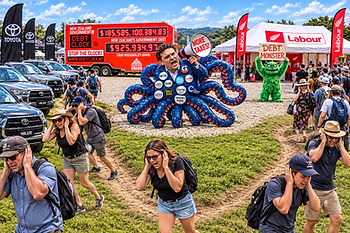
At the Hawke’s Bay A&P Show, voters wore a path through the grass to avoid the Taxpayers’ Union. The overhang campaign it sits beside deserves the same wide berth.
On Thursday and Friday I stood beside the Toyota Hilux display at the Hawke’s Bay A&P Show. As vantage points go, it was perfect.
Lined up beside the utes, from right to left, were stalls for National, Opportunity, New Zealand First, Labour and the Taxpayers’ Union, with ACT around the corner. In front of a trailer carrying the Union’s ‘Debt Clock’ stood its executive director, Jordan Williams.
It was the last big crowd before voting opened on Monday, Labour Day, so every party sent its leaders. What I watched over those two days captured the mood of this campaign better than any poll.
This was the election for Jordan Williams to lose. The question now is how much he has lost — and who goes down with him.
Contents
The view from the Hilux
Body language never lies, and the showgrounds were full of it.
Opportunity’s tent was the busiest, and its volunteers roamed the grounds in their bright t-shirts. National and Labour MPs moved in scrum formation. New Zealand First’s candidates huddled in their corner tent, with Taine Randell spending most of Friday tending a slow-cooked rib he reckoned would take seven hours. I am not sure it was ready by closing time.
I don’t know how the stall sites were allocated. On camera, Williams asked Christopher Luxon whether parking the Debt Clock beside Labour was a coincidence. The Prime Minister called it “entirely appropriate”. To the Labour volunteers inside, it looked like intimidation.
What happened next was more telling. Williams planted himself in the middle of the main path, and the crowd gave him a wide berth. That steered foot traffic away from Labour’s tent and, because another display sat beside ACT’s tent, into a bottleneck that pressed people uncomfortably close to ACT’s politicians and volunteers.
Williams posted his interviews with Luxon and Randell to the Union’s Facebook page. Cosy, to say the least. He opened the Randell clip by telling the old boy of his own school that he had done “bloody well in our poll”, and captioned him a future “Taxpayer Hero, maybe”. Randell, to his credit, conceded that most showgoers had no interest in talking to a politician.
Not everyone played along. The Herald’s Adam Pearse reported that Luxon, cornered in a throng, greeted Williams as a stunt master and asked why he didn’t do something serious with his life. The Union also dispatched a costumed ‘Debt Monster’ to disrupt Chris Hipkins’ media stand-up.
Rather than pass him, people cut through the Toyota stand. By Friday afternoon they had worn the grass bare.
The tent you would miss
A hundred metres down the main path was the Electoral Commission. Blink and you missed it.
It was not the bright orange, hard-to-miss obstacle you would expect days before enrolment closed. And they didn't even advertise the tent on their post on their social media accounts.
And this year that mattered more than ever.
Under the Electoral Amendment Act 2025, enrolment closed at midnight on Sunday 25 October. For the first time in years, nobody can enrol at the voting place.
Electoral law expert Andrew Geddis warned The Spinoff that the change risked a “looming disaster” for groups already drifting off the roll. The Commission’s own enrolment strategy set a target of 94.7% enrolled before voting began.
When enrolment closed on Sunday night, 300,000 eligible New Zealanders were still unenrolled, the Herald reported. They cannot vote this election.
The loudest stall on the main path told you what to think. The quietest one was trying to make sure you could vote.
The stench
Williams arrived at the show carrying baggage he packed himself.
Last month Nicky Hager published Dirty Work, the third book in his trilogy on the right, and this one is about the Taxpayers’ Union. The Spinoff’s coverage carried the phrase “rotten stench” in its headline. Williams denies the book’s allegations, Hager’s lawyers said none were criminal, and Curia founder David Farrar called it “1000% wrong”.
But perception is the currency of a campaign, and the Union trades on it. I have documented its astroturf network since 2020. Voters do not need to read a book to sense it. They just walk around it.
Some smells don’t wash off. They just follow you from tent to tent.
The template
I made two predictions this year. I never expected them to become a playbook.
In April I set out the overhang trap: National winning more electorates than its party vote earns, and its list emptying out. In June, in Hawke’s Bay Today, I argued that Napier and Tukituki could decide who governs, and noted that almost nobody was polling them.
Since then the right has turned the arithmetic into a campaign. Harry Mowbray’s Split Your Vote website urges National supporters to give their party vote to ACT or New Zealand First while electing National’s local candidates, Bryce Edwards reports, with Mowbray talking up an overhang of up to 40 seats. Don Brash has urged the same split.
ACT has embraced it too, with an advert fronted by Paul Henry asking voters to party vote ACT and give their electorate vote to a local MP — while insisting it is not an attempt to create an overhang. I analysed that two-step last week.
None of this is new. I argued in Stuff back in 2013 that politicians abuse the flaws of MMP. The Electoral Commission recommended abolishing overhang seats in 2012, and the Independent Electoral Review said it again in 2023. Neither major party acted.
A prediction is a warning. Some people read it as an instruction.
A poll on demand
Nobody was polling Tukituki, so I dared the Taxpayers’ Union to.
Days after New Zealand First ranked Randell ninth on its list — enough to put him in Parliament on current polling — and launched a TV advert pairing him with Winston Peters during the Bledisloe Test, the Union obliged.
Its Curia poll was released at the start of the Union’s own Tukituki debate in Havelock North, Hawke’s Bay Today reported. National’s Catherine Wedd led comfortably on 35%, Labour’s Dan Scott trailed on 20%, and Randell polled a credible 15%. Opportunity got 4% of the party vote — conveniently under the threshold. Within a day or two, Williams was using the result as his opening line at the show. The debate itself ran in the Herald as sponsored content.
In other words, the poll delivered exactly what the coalition and its boosters want: a safe National seat, a respectable debut for Peters’ successor-in-waiting, and Opportunity below the line. Nationally, the latest RNZ-Reid Research poll has Opportunity on 5.5% and holding the balance of power.
A poll commissioned by a lobby group and unveiled at its own event is not a measurement. It is a message.
Follow the money
The overhang campaign has a funding question, and nobody has answered it.
In April 2024, Reality Check Radio went off air citing a financial crunch and begged listeners for money, with a donation target of $480,000.
In 2024 Reality Check Radio was begging for donations. In 2026 it is buying full pages in the Herald.
It is now a registered third-party promoter — from 9 October, according to The Daily Blog — running billboards around the country, including near Parliament, and full-page Herald adverts for its Vote Smart 2026 campaign. The campaign page features Brash, Maurice Williamson, Peter Williams, Cam Slater and Mowbray explaining overhangs and ‘wasted’ votes.
Registering lifts the spending cap from $17,000 to $424,000.
The timing is worth noting. On The Platform, Sean Plunket referred to a meeting at Mowbray’s Coatesville home and a fundraising target of $400,000–$500,000, Edwards reports. Ani O’Brien says she gave paid advice that a full campaign was not possible under electoral law, then walked away. Mowbray denied the Taxpayers’ Union was involved, while acknowledging he had Williams to lunch. He says the collective project was abandoned and he would spend no more than $17,000 himself.
Registered promoters who spend over $100,000 must file a return of their expenses — after the election.
Voters will have cast their ballots before they learn who paid to tell them how.
Is it legal?
Splitting your vote is legal. Organising others to do it is where the law starts to bite.
The overhang itself is lawful. Asked about it, Geddis told The Spinoff simply that it is legal, and Edwards agrees the resulting seats would be lawful even as he calls for the rule to change.
The advertising is another matter. A third party publishing an advert that encourages people to vote for a party needs that party secretary’s prior written authorisation under section 204H of the Electoral Act, and the cost counts against the party. When Sir Patrick Hogan ran unauthorised adverts backing New Zealand First, Geddis said it could amount to an illegal practice.
Mowbray says he has no authorisation from National, ACT or New Zealand First, and David Seymour says ACT was never approached. Reality Check Radio’s page names no party and tells viewers to make up their own minds — wording that looks carefully built to sit outside section 204H.
Then there is section 204D: an unregistered promoter may not enter an arrangement to get around the $17,000 cap, and a wilful breach is an illegal practice. Whether anything like that happened is a question, not a finding. Mowbray says the joint plan died; The Daily Blog’s tip-line claims are untested.
And the body that could find out has no power to compel evidence from third parties.
The overhang is lawful. Whether the machinery behind it is lawful is a question nobody is equipped to answer.
The backlash
Voters are not stupid. They can smell it.
There has been criticism of the media’s coverage, of the major parties, and of the money and the third parties. Opportunity’s rise is the clearest sign of a public wanting change.
Its five bottom lines include regulating lobbying and capping donations to “clean up politics”, and its policy promises an independent anti-corruption body. The same standard applies to it: Opportunity has taken more than $400,000 in large donations this year while campaigning to ban them.
I hope it holds the line. An anti-corruption commission has been promised for 33 years and has died at the negotiating table every time.
A bottom line only counts if you are prepared to walk away for it.
Jordan Williams stood in the middle of the path, and the crowd walked around him. If voters do the same on 7 November, he will be the biggest loser of an election he was never on the ballot for.


