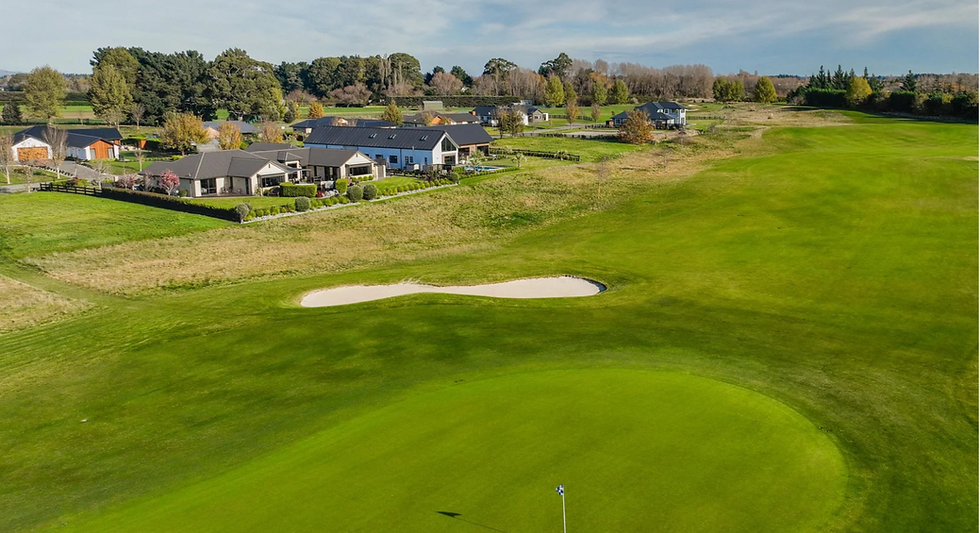
Pegasus Brief — The end of the beginning


The government has declined Wolfbrook Developments Limited’s application to fast-track its 1,000-home Pegasus West project — but the fight over the former Pegasus Golf Course is far from over.
How the news broke
There was no press release.
The decision on Wolfbrook’s application to refer the Pegasus West Development to the fast-track process was quietly posted to the Ministry for the Environment’s Fast-track Approvals Portal on the afternoon of Wednesday 19 August 2026, with no accompanying announcement from the Minister for Infrastructure, Chris Bishop, or his office.
It fell to the public, rather than the government, to break the news. Waimakariri MP Matt Doocey posted the decision to Facebook at 5.18pm, welcoming it and congratulating the Pegasus Residents’ Group on its coordination of the opposition. Eighteen minutes later, at 5.36pm, the Pegasus Residents’ Group itself posted to Facebook.
Mainstream media coverage followed within the hour. Chris Lynch Media was first to publish, at 5.42pm, reporting that the decision had been made “just three weeks after the formal application was lodged on 29 July.” RNZ, The Post and the New Zealand Herald each filed within the same window.
The Waimakariri District Council was last to react publicly, posting to Facebook at 7.25pm — more than two hours after the decision had already been circulating in the public domain, and well after residents, an MP and four newsrooms had covered it. Local station Compass FM also carried the community reaction.
The sequence is itself instructive: a decision of genuine regional significance, on a process the government markets as more transparent than the Resource Management Act it partly bypasses, reached the public not through the Minister’s office but through a citizen MP’s phone.
What the decision actually says
The notice of decision, reference FTAA-2607-1267, confirms the application — lodged by Wolfbrook Developments Limited for the 77-hectare, fifteen-parcel Pegasus West Development at 9 Mapleham Drive — was accepted for consideration by the Minister under section 21 and referred under section 26, before ultimately being declined referral to the substantive fast-track approvals stage.
The Minister declined the referral under sections 21(4) and 21(5)(b) of the Fast-track Approvals Act 2024. The stated reason is narrow and procedural rather than a rejection of the development on its merits. The Minister
“considered it would be more appropriate to deal with the matters that would be authorised by the proposed approvals under another Act or Acts.”
In practice, that sends Wolfbrook back to the Resource Management Act — and back to the Special Purpose Zone (Pegasus Resort) provisions of the Waimakariri District Plan, under which residential development on the former golf course remains a non-complying activity.
The project would have required resource consents and the cancellation of an existing consent condition under the RMA, Conservation Act concessions relating to the Brockenhurst Wetlands, Wildlife Act permits, archaeological approvals under the Heritage New Zealand Pouhere Taonga Act, and potentially approvals under the Freshwater Fisheries Regulations — the same layered consenting burden fast-track was designed to bypass.
What the decision means — and whether Wolfbrook can try again
A declined referral is not a permanent bar.
The Act allows a declined applicant to apply for referral again, but the government has been explicit that a fresh application is treated as an entirely new one — attracting new fees and requiring the pre-lodgement process, including twenty working days’ notice to affected parties, to be run again from scratch.
The Minister also retains an unreviewable discretion: section 21(3) requires him to decline where the criteria are not met, the activity is ineligible, or the information is inadequate, but the Act separately gives him discretion to decline “for any other reason, whether or not the project meets the criteria in section 22.”
That is a wide door left open, and a narrow one for Wolfbrook to walk back through.
What is not in doubt is that the development, in its current form, is dead.
Wolfbrook cannot proceed to 1,000 homes on Pegasus without either a successful second fast-track application, a full RMA consenting process fought against a non-complying activity status, or a plan change — each considerably slower and more exposed to public and judicial scrutiny than the pathway it chose and lost.
What it has done to Pegasus’ value to Wolfbrook
Wolfbrook acquired the course in a mortgagee sale in May, reportedly for between $6 million and $7 million.
Industry figures cited by the Herald had put the land’s value at as much as $400 million if successfully rezoned for housing. That gap was always the entire commercial logic of the purchase — and today’s decision has just removed the fastest route to closing it.
Wolfbrook can still land bank the site: hold it, let the course continue to sit closed and deteriorating, and wait for a second fast-track attempt or a more favourable political or planning environment.
Nothing in the decision compels Wolfbrook to reopen the course, maintain the grounds, or preserve public access to the walking tracks residents have used for years. Whether it chooses to do any of that is now entirely a matter of its own commercial discipline and public-relations judgement, not legal obligation.
A vacant 77-hectare former golf course sitting idle and fenced in the middle of a small town is not a good look for a developer that has already absorbed four months of sustained, unflattering national coverage.
Who’s circling
There is more than one party interested in buying the land off Wolfbrook for close to what it paid.
The Waimakariri District Council has already signalled publicly that it is working with the Pegasus Residents’ Group and local businesses to explore a community-led purchase, and has said it intends to present Wolfbrook with a viable proposal as an alternative to development if one can be assembled.
For Wolfbrook, a sale at or near acquisition cost would be a clean, face-saving exit from a project that has cost it far more in reputational capital than the $6–$7 million purchase price ever risked in financial capital.
Time to find the exit
Wolfbrook should take the sale option seriously, and quickly.
Continuing to hold Pegasus — through a second fast-track bid, a drawn-out RMA process, or simple land banking — keeps the story alive, and keeps every other media outlet that has now covered this saga, returning to it.
That is not a threat. It is simply what happens when a company sits on a live, unresolved community grievance.
The commercially rational move is to accept that this particular bet did not pay off, sell the land to the council or another community-aligned buyer for what was paid for it, and move on.
Wolfbrook has other projects and other investors. None of them benefit from being permanently associated, in search results and in the minds of Canterbury voters, with a company that tried to bulldoze a small town’s golf course through a fast-track law and lost.
The Pegasus Residents’ Group deserves real credit here. Its petition, its communications, and its coordination with local MPs and the mayor have been exceptional — all the more so given the scale and resources of the opponent it was up against.
The fast-track decision is the outcome many expected. What comes next — whether the course is left to fall into disrepair, whether public access to the walking tracks is blocked, whether Wolfbrook land banks or sells — is not yet known.
As Winston Churchill said after the Battle of El Alamein: “Now this is not the end. It is not even the beginning of the end. But it is, perhaps, the end of the beginning.”
Timeline
5.18pm — Matt Doocey posts the decision to Facebook
5.36pm — Pegasus Residents’ Group posts to Facebook
5.42pm — Chris Lynch Media publishes first media report: chrislynchmedia.com
Evening — RNZ: rnz.co.nz
Evening — The Post: thepost.co.nz
Evening — New Zealand Herald: nzherald.co.nz
7.25pm — Waimakariri District Council posts to Facebook