The “I know a guy” threshold: How Brick Bay Lodge was fast-tracked on the vaguest of details

Updated: Aug 22

A 45-suite luxury lodge on a Snells Beach wine farm won referral to the fast-track process while Auckland Council said the economic case did not stack up — and the public only found out after the Minister had already signed off.
On 30 July 2026, the Minister for Infrastructure, Hon Chris Bishop, referred the Brick Bay Lodge project to New Zealand’s fast-track approvals process. Eighteen days later, the wider public heard about it for the first time, in a short Local Matters item in which the landowner, Richard Didsbury, mused about treehouse designs and an unnamed American partner.
By the time that story ran, the substantive decision had already been made.
The real question is not whether Brick Bay Lodge might one day get built. It is why a 45-suite luxury tourism development, on land the council’s own strategy says will not be developed before 2053, needed the fast-track process at all — and why the process that granted it moved almost entirely out of public view.
Contents
The numbers that unlocked the door
The Fast-track Approvals Act 2024 only lets a Minister refer a project if it would deliver ‘significant’ regional or national benefits.
For Brick Bay Lodge, the applicant’s economic case, accepted in the Minister’s notice of decisions, claimed 20,000 to 25,700 additional visitor nights a year, up to $177 million in value added from operational spending, 243 jobs a year once running, and a $390 million greenfield foreign equity investment, including $25 million for the land itself.
Those figures were enough.
The Minister accepted the referral under section 21(1)(c) of the Act, finding the project met the significance threshold and that fast-tracking it would let it bypass public and limited notification under the Resource Management Act, with any later appeal confined to the High Court on points of law. Fast-track New Zealand classifies the project under its ‘Housing/land’ sector, despite it delivering zero housing.
That case rests on a foundation weaker than the headline numbers suggest.
Market Economics Ltd, the consultancy engaged to write the assessment, discloses in its own caveats that the operational and financial projections behind the $390 million figure came directly from the developer’s financial model, and states plainly that these parameters were not independently estimated or verified by the consultants themselves.
The number that cleared the significance threshold is, by its own authors’ admission, the applicant’s unverified assumption about a foreign investor nobody has named.
A council that said no anyway
Auckland Council told the Minister it did not support the project going any further.
Its Chief Economist Unit reviewed the same economic case and reached the opposite conclusion: the benefits, while real, were not ‘significant’ at a regional or national scale. Scaled against Auckland’s roughly $165 billion annual GDP, the council’s economists put the project’s impact at about 0.09 per cent of one year’s output spread across a 30-year appraisal period, and its 150 or so ongoing jobs at roughly 0.015 per cent of Auckland’s workforce. The 45 new rooms would lift Auckland’s total accommodation stock by an estimated 0.3 per cent.
Auckland Council’s own Parks, Chief Economist and planning teams all raised concerns — and the Minister overruled every one of them.
Council planners also pointed out that visitor accommodation is only a discretionary activity in the Rural Coastal Zone, meaning the project could be processed through an ordinary resource consent without any plan change, undercutting the claim that fast-track referral was necessary to ‘facilitate’ delivery.
Auckland’s Future Development Strategy 2023–2053, the document that maps where growth is meant to happen, does not anticipate any development of this site for the length of that thirty-year horizon.
Council’s Parks and Community Facilities team separately opposed referral over unassessed effects on the adjoining public reserve.
Pegasus: the same test, a different answer
One day after the Minister referred Brick Bay Lodge, Wolfbrook Developments Limited lodged its own referral application for Pegasus West, a 1,000-home development on 77 hectares of former golf course north of Christchurch, on 29 July 2026. On 19 August, Bishop declined it.
The Minister declined Pegasus West under sections 21(4) and 21(5)(b) of the Act, finding it would be more appropriate to deal with the matters through the Resource Management Act than through fast-track. That is precisely the ground Auckland Council raised against Brick Bay Lodge, telling officials the project could be progressed through established RMA consenting pathways without a plan change.
For Brick Bay Lodge, officials dismissed the point in a single line: no reports or comments received had indicated it would be more appropriate to deal with the matters under another Act. For Pegasus West, the same provision was the entire basis for decline.
Auckland Council raised the identical objection against Brick Bay Lodge that got Pegasus West declined a fortnight later.
One was dismissed in a sentence.
The other ended the project.
The commercial logic in both cases was identical.
Wolfbrook bought Pegasus for an estimated $6 million to $7 million, with industry figures putting its rezoned value at up to $400 million: a fifty-to-sixty-times uplift riding entirely on consenting status, not construction.
Brick Bay Lodge’s referral notice puts a $390 million valuation on land Auckland Council’s Future Development Strategy does not expect to be developed before 2053.
Both projects asked the fast-track process to manufacture, in weeks, a jump in land value that ordinary planning processes would take years, if ever, to deliver. One was declined. One was not.
Approved before anyone knew to ask
The referral application was lodged on 8 May 2026. Comments closed 30 June. The Minister signed off on 30 July.
Local Matters published its story on 17 August — after every substantive decision in the process had already been made, and framed entirely around Didsbury’s own account of an early-stage idea still needing a builder, a funder, and a name for its mystery American partner.
That framing sits awkwardly against the paper trail.
By the time the story ran, a quantified $390 million investment case had already been assessed, tested against objections from Auckland Council, the Department of Conservation and Heritage New Zealand, and formally accepted by a Minister of the Crown.
There is also an unresolved discrepancy in the record itself: the Minister’s own notice of decisions names the applicant as Richard and Christine Didsbury personally, while a 9 June 2026 email from the Infrastructure portfolio to fellow Ministers describes the applicant as Brick Bay Wines Limited.
Neither the article nor the public file explains which is correct, or why they differ.
The Didsbury playbook: Boathouse Bay
This is not the first time a development next to a Didsbury property in this stretch of coast has been approved without the scrutiny that would normally apply.
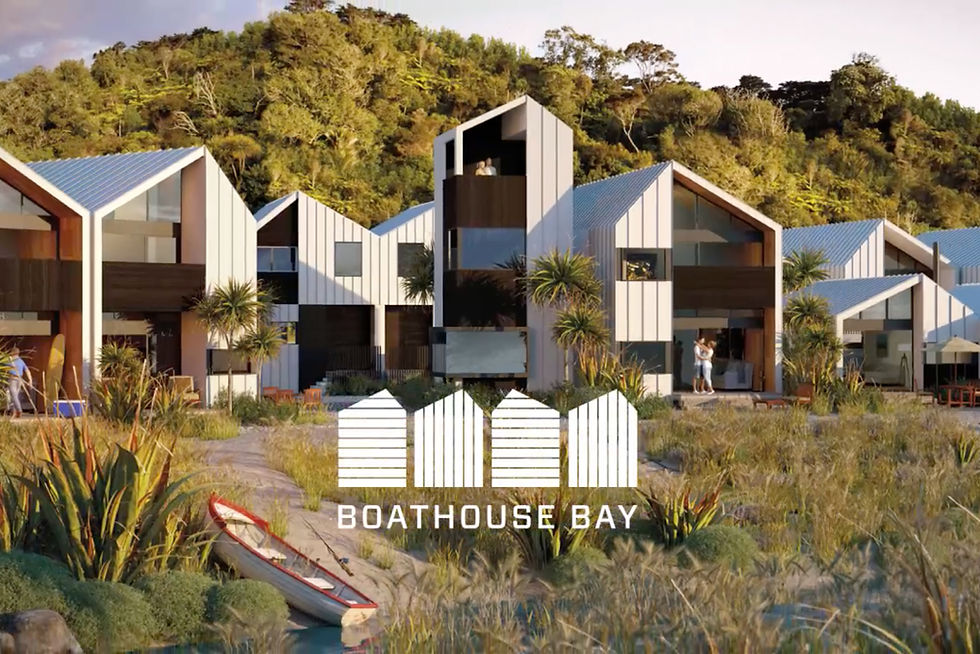
In 2017, I documented how the neighbouring Boathouse Bay development — 33 dwellings on a site the operative district plan would otherwise have allowed only two — secured Auckland Council resource consent without public notification, after Council planning staff circulated draft conditions to the applicant ahead of a formal decision.
Richard Didsbury’s role in that outcome was, by his own account at the time, non-existent. Documents tell a different story.
The written neighbour approval used to keep the one independently owned adjoining lot off the notification list was supplied by Richard John Didsbury, Christine Didsbury and Brick Bay Trustee Limited, as owners of the neighbouring development.

It was not attached to the resource consent application when consent was granted: the appendix reserved for it in the application reads only ‘To follow.’

On 23 December 2015, the day the resource consent application was lodged, Didsbury and Christine Didsbury, acting as trustees of a vehicle called Brick Bay Development Trust, agreed to buy 3.35 hectares next to the site for $1,043,500. Whisper Cove Heights Limited, a company half-owned by Didsbury’s own Brick Bay Trustee Limited and of which Richard Didsbury was himself a director, simultaneously agreed to buy a smaller adjoining lot for $478,261.


The two purchases were made conditional on each other and on a separate Development Agreement between the vendor, Whisper Cove Heights, and the Brick Bay Development Trust: Didsbury interests sat on both sides of the split.
A confidentiality clause barred either party from disclosing the price or terms.

Clause 19 went further than passive approval: it contractually bound the purchaser to consent to and support the vendor’s resource consent application for the wider high-density subdivision.

The Brick Bay Development Trust’s name is not incidental. It is the same branding now attached to the Brick Bay Lodge referral a decade later, and the Boathouse Bay site itself sits inside a council heritage overlay named Area 57, Brick Bay.
Under the operative district plan, Boathouse Bay’s 33 dwellings breached height, height-to-boundary, site coverage and carparking rules and were processed as a non-complying activity; under the incoming Unitary Plan, eleven of the dwellings breached height limits and twenty breached yard-size rules, on a site carrying a recorded pa with terraces, pits and midden.

The developer of record, Mat Peters, was separately adjudicated bankrupt in the High Court at Auckland over unpaid debts to finance company Marac, after developing the eight-storey Quba apartments in downtown Auckland.
What is most concerning is that the previous owner of the Boathouse Bay site tried to subdivide the same property into 17 residential lots. The council wanted to publicly notify that application and take a wide esplanade reserve, which would compress the development significantly. The application was withdrawn.
Boathouse Bay is 33 residential dwellings, claimed part of the foreshore, did not offer any esplanade reserve between the dwellings and the foeshore, was not notified at all, was predetermined, destroyed a habitat for threatened shorebirds, and significant coastal erosion resulted.
If you placed the 17 and 33 lot subdivision applications side by side, the difference was Didsbury's involvement.
Effectively, Peters traded on Didsbury's reputation and influence, and Didsbury financially benefited from it.
The pattern holds: what he told the press this time
On 17 August 2026, the same publishing group that ran Mahurangi Matters in 2017 carried, uncontested and without a byline, Richard Didsbury’s own account of the Brick Bay Lodge project.
He said the first step had been taken with an application for referral to fast-track. By then the Minister had already referred the project, eighteen days earlier, on the strength of an economic case his own consultants say they never verified.
He described the project as being at an early stage, with funding still to be assembled and resource consent still to be obtained.
Both statements are true as far as they go. Neither mentions that the harder procedural step, the one that removes the public’s right to be notified and narrows any appeal to a point of law in the High Court, had already been won.
The unnamed American partner behind Brick Bay Lodge’s economics is the same device that shielded the price of Didsbury’s Boathouse Bay land deal a decade earlier: confidentiality invoked exactly where verification would matter.
He named an American partner behind the project’s economics without naming the partner, calling the detail confidential.
No comment from Auckland Council, the Department of Conservation, Heritage New Zealand or Watercare appears anywhere in the piece, despite all four having placed serious, unresolved concerns on the public record weeks earlier.
The masthead has been here before.
In 2017, Didsbury pressured Mahurangi Matters into retracting a resident’s letter that had questioned the Boathouse Bay consent, printed an apology to his family for a claim she never made, and refusing to publish any letter in her defence. This classic snow job tactic was designed to hide his involvement with the Boathouse Bay development. The Mahurangi Matters owner told me in writing that she had been bullied into it.
The Brick Bay Lodge story, as published, tested none of Didsbury’s claims against a public record that, by the date of publication, already contradicted several of them.
Moving a war memorial for a toilet
Didsbury’s reach extends well beyond Matakana’s farmland.
He co-founded what became Kiwi Property Group with Ross Green in 1992, listing it on the stock exchange the following year. The company went on to build Sylvia Park, one of Auckland’s largest retail and mixed-use developments. He held directorships at Sky City, Auckland Airport, and developments at Hobsonville, Albany, and Puhoi. He was appointed chair of the NX2 consortium behind the Puhoi to Warkworth motorway public-private partnership (where the single largest shareholder was ACC), which would benefit his developments in the area.
Long before Brick Bay Lodge, Didsbury’s most consequential Matakana project may have been one he did not build: the relocation of the Matakana War Memorial.
By the early 2000s, Didsbury owned the timber yard site on the corner of Leigh and Matakana Valley Roads and was planning a restaurant, retail and farmers’ market development on the riverbank, beside the reserve holding the district’s First World War memorial: a statue of King George V unveiled in 1920, funded by public subscription, dedicated to thirteen local men who died in the war.
In November 2002, Didsbury and his wife offered $7,500 of a $10,000 prize fund for a design competition for new public toilets on the reserve. A September 2003 advertisement invited public comment on his proposed waterwheel restaurant; it made no mention of the war memorial standing metres away.
The day before a public open day on the toilets, Didsbury’s consultants, Isthmus Group, faxed the council plans that already showed the memorial relocated, complete with landscaping around its proposed new site. The council’s own plans for the reserve still showed the memorial where it had stood since 1920.
Sixty attended the Open Day. In the notes made by Lisa Gapes, after the names ‘Gaye Smith’ and ‘Rusty Tui –Lisa’ appear and before ‘Errol Jones’ is the comment in different coloured pen and handwriting "RSA Monument – move down road."
It is not known who made this suggestion.
Council project manager Peter Bilton said that the business owners opposite the reserve – The Rusty Tui (owned by Lisa and Ian Raklander) and the service station (owned by Gaye Smith) – were led to believe that the public toilets would be located at the current site of the war memorial immediately adjacent to their businesses and were vehemently against that, preferring the war memorial to be relocated instead.
No documents in the councils files show any plans to locate the public toilets anywhere near the current location of the Monument. Local businesses were misled to support Didsbury's proposals.
When the council later applied for its own resource consent to move the memorial, its planning officer recommended the application be publicly notified, citing the memorial’s significant historic value, its 86 years on the site, and its prominence to the community. The council instead appointed an independent commissioner, Greg Hill, who recommended against notification, justifying his decision with a slew of factual errors.
Hill’s decision rested partly on a claim that the Warkworth Returned Servicemen’s Association, described as the memorial’s caretaker, had given written support to the relocation. No such letter exists in the council file, and the Warkworth RSA holds no record of ever writing one.
The planning officer who processed the application later said she was surprised by the decision and recalled being pressured by the council’s roading department to push the relocation through. Those involved in the roading department were later involved in a "cascading culture of bribery" the country's largest corruption case.
The stated trigger for moving the memorial was a roundabout upgrade at the intersection, made necessary in part by the extra traffic generated by Didsbury’s own farmers’ market, restaurant and retail development. The council’s own application records that the roundabout would encroach into the reserve and the memorial’s existing location: public reserve land absorbed the realignment, not any land contributed by the development driving the additional traffic.
The memorial was relocated in 2006. A public toilet block, costing more than $130,000, was built on its former site and opened in 2009. Didsbury’s retail and hospitality development on the corner, by then known as Matakana Village, was complete by 2008.
I documented all of this when I prepared the heritage application for the Matakana War Memorial.
The pattern is consistent with what would recur at Boathouse Bay a decade later, and arguably with Brick Bay Lodge today: a development that needed a public process concession to proceed, obtained through a notification decision that did not run the way the record shows it should have, resting on a claim that did not hold up once tested.
What still is not resolved
Even on the applicant’s own paperwork, Brick Bay Lodge is a long way from a finished proposal.
A full wetland delineation survey has not been done, which officials noted could trigger a prohibited activity under the National Environmental Standards for Freshwater.
Heritage New Zealand has identified seven recorded archaeological sites in the project footprint, three of which the application proposes to modify or destroy, and no cultural impact assessment has yet been supplied.
The Department of Conservation wants further investigation into bat habitat, wetland ecology and nesting korora, or little penguin, before it will form a view on effects.
Watercare has confirmed it has no long-term plan to service rural-zoned land like this site, leaving the lodge dependent on a private wastewater plant and rainwater or bore-water supply.
And the application refers to on-site ‘events’ without specifying their scale, frequency or nature, a gap Auckland Transport flagged as impossible to assess.
Questions that deserve answers
Who is Brick Bay Lodge’s applicant of record: Richard and Christine Didsbury, or Brick Bay Wines Limited, and why do government documents disagree?
Who is the unnamed American partner behind a $390 million equity claim that its own authors say they never verified?
Why did the Minister accept a referral that Auckland Council’s own economists, planners and parks staff each separately opposed, on the same statutory ground that sank Pegasus West a fortnight later?
With a wetland survey outstanding, no cultural impact assessment filed, and three archaeological sites slated for destruction, what exactly was so urgent that it justified removing the public’s right to be notified? And given the written approval that helped clear the way for Boathouse Bay was never disclosed until journalists forced it into the open, what assurance is there that Brick Bay Lodge’s own paper trail will fare any better?
Brick Bay Lodge did not need fast-tracking to be built. It needed fast-tracking to be approved before anyone outside the process could ask why.
REFERENCES: Fast track documents
With so many unasked and unanswered questions, I invite readers to look at the paperwork and form their own opinions. Look past all the stock photos, the cut-and-paste fluffy jargon, the schematics that arbitrarily scatter building footprints throughout the site (including right in front of Didsbury's house and pavilion), and compare what the council experts said versus the government's. Is this application, with no identified "foreign investor", just a "pump and dump" to boost the property value so to offload to a potential bolthole billionaire? Are the other luxury lodges around the country worth $390 million? And even if consent is given, is there any requirement for the yet-to-be-found developer to follow through with what the application proposes?
Check out the "masterplan" here and fast track documents below: