Why does it take a foreign watchdog to catch a New Zealand official?

Updated: Jun 20

John Edwards is the latest senior New Zealander official who rose at home and was brought to account abroad. The pattern says more about our institutions than theirs.
On Friday, John Edwards resigned as Britain’s Information Commissioner — the role he moved into after a 2014–2021 term as New Zealand’s Privacy Commissioner. He had stepped aside in February for an independent workplace investigation, which this month found he had a “case to answer”.
Edwards has acknowledged “poor judgement” and “attempts at humour that were inappropriate and caused offence”.
Britain’s Science Secretary, Liz Kendall, went considerably further, saying publicly she had seen evidence of vulgar and highly sexualised language used in his dealings with staff.
Set aside the conduct itself, which Edwards disputes in part and whose full findings remain unpublished.
The harder question for New Zealanders is structural.
Edwards is the latest senior New Zealand official in a decade to climb the ranks without serious challenge at home, take a prominent post overseas, and there meet a kind of scrutiny this country never seemed to muster.
So it is worth asking plainly: who watches the watchers here?
Contents
The privacy commissioner

Edwards was an unusually combative regulator.
In Britain he fined TikTok, Reddit and 23andMe, and earned £200,000 a year — more than the Prime Minister he served.
The British outlet ComputerWeekly reported that he kept drawing that salary after February while back in New Zealand and not working.
In Wellington, his seven-year term drew little of the friction that ended his British one. He lobbied, unsuccessfully, for the power to fine firms up to $1 million, and largely set his own public tone.
Whatever one concludes about the British investigation, it is difficult to picture a comparable process running its course here.
The judge

The pattern predates Edwards by more than a decade.
As a High Court judge, Dame Lowell Goddard presided over the 2002 trial of Bruce Howse, convicted of murdering his partner’s two young daughters. On appeal, the Privy Council in London — then still New Zealand’s court of final appeal for cases like his — delivered rare and scathing criticism of how the trial had been run, describing it as “a trial that has gone off the rails” and noting that it could have used more robust language but restrained itself.
It took a British court to say so.
At home, Goddard was nonetheless made the first chair of the Independent Police Conduct Authority — a body whose investigations are conducted largely in private, with little outside check on the quality of its work.
In 2015 she went to Britain to chair its vast Independent Inquiry into Child Sexual Abuse, on a pay-and-benefits package reported at more than £480,000 a year — among the highest in the British public service.
She struggled almost from the start: at a preliminary hearing she appeared not to grasp her own powers under the Inquiries Act 2005 — the very statute that had created the inquiry — and legal sources later described her grasp of English law as “blurry”.
Eighteen months later she resigned, the third chair to quit, having spent more than 70 days abroad or on leave in her first year while the inquiry heard not a single piece of evidence.
Her brief resignation letter gave no reason — and misnamed the very inquiry she had been running.

When the Home Affairs Committee asked her to explain herself to Parliament, she declined, dismissing The Times’ reports of racism and rudeness, which she denied, as a malicious campaign.
The hard questions, once again, were asked abroad.
Each rose without serious challenge at home. Each was stopped by an institution somewhere else.
The embodiment of corruption

The bluntest case is Rodger Kerr-Newell, once chief executive of the Rodney, Hutt City and New Plymouth councils.
After moving to run the remote Shire of Halls Creek in Western Australia, he became the subject of a two-year investigation by that state’s Corruption and Crime Commission.
Its 2018 report found serious misconduct over undeclared conflicts of interest and misused entitlements, and described his conduct as “the very embodiment of corruption”.
He was sacked.
In New Zealand, by contrast, the Auditor-General had earlier found his Rodney exit payments breached statutory requirements — yet concluded it had no power to claw the money back.
The police chief
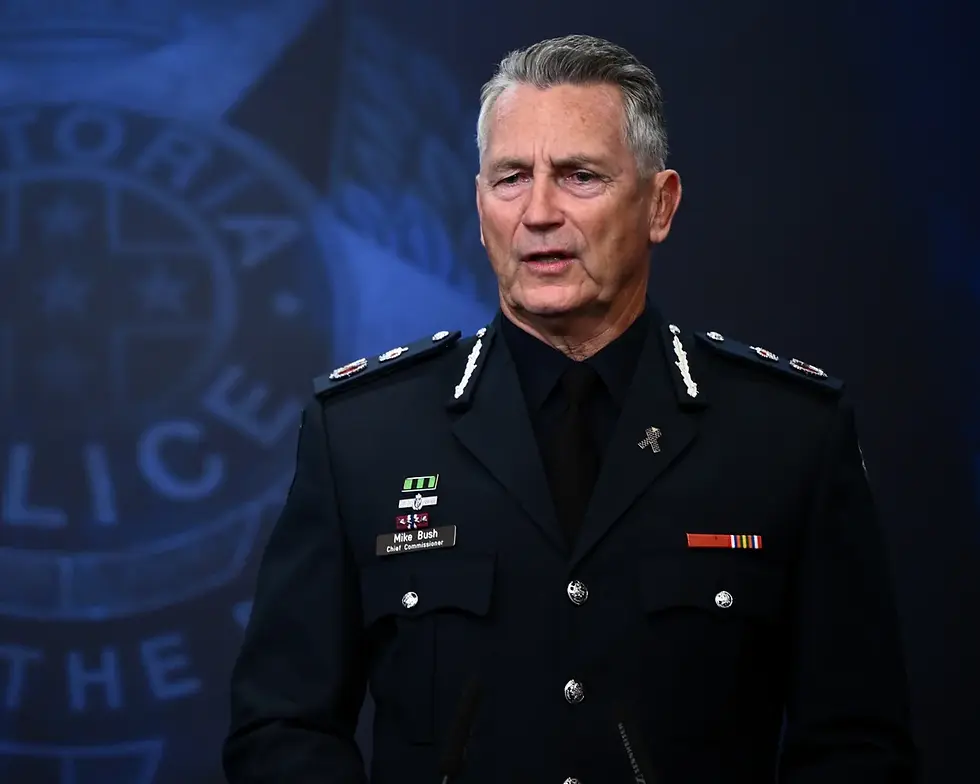
The newest export is Mike Bush, Commissioner of New Zealand Police from 2014 to 2020 and, since June 2025, Chief Commissioner of Victoria Police.
Within months he had handed his critics an easy target.
In October he apologised for using a Victoria Police Air Wing helicopter to reach the Australian and New Zealand Police Commissioners’ Forum in Hobart — a route a commercial airline covers in about an hour — with New Zealand’s own Police Commissioner, Richard Chambers, along for the ride.
Bush conceded the trip “didn’t pass the pub test.” It later emerged the same Air Wing had separately flown his wife and two visiting New Zealand officers in his first weeks, though the force said Bush himself was not on that flight.
With public confidence in Victoria Police sitting around 62 per cent, a Melbourne police-misconduct lawyer made the obvious point: a chief who reaches for the force chopper will struggle to “call out bad behaviour” in the ranks he was hired to reform.
It was not the first time culture had shadowed his leadership.
A 2020 exit profile in the NZ Herald recorded staff describing parts of the police executive as “toxic”, alongside an Independent Police Conduct Authority inquiry into a potential culture of bullying.
The sharpest test was Wally Haumaha, whom Bush backed for deputy commissioner — despite Haumaha’s widely reported earlier support for officers at the centre of the Louise Nicholas rape case — and kept publicly backing after the IPCA found some of his conduct “inappropriate and unprofessional”.
At select committee, Bush refused to say whether the affair had dented confidence in police culture. None of it slowed his rise to a bigger job across the Tasman.
Who is watching here?
Four careers, three countries, one through-line.
Britain ran an independent investigation and a parliamentary inquiry.
Western Australia stood up a standing corruption commission with teeth.
In Victoria, the rank and file can vote no confidence in their chief and end his tenure.
New Zealand offers none of those.
None of this proves wrongdoing by anyone who served here. The point is narrower and harder to dodge: when hard questions did arise, the tools to test them properly tended to sit in someone else’s jurisdiction.
At home, concerns have a way of dissolving into reviews that find conduct “inappropriate” but below some threshold, after which everyone moves on.
New Zealand still has no independent anti-corruption commission, and several of its watchdogs answer to little external oversight of their own.
New Zealand still sits near the top of the world’s clean-government rankings — but its score has slipped four years running. Lately it has taken other countries’ watchdogs to test whether we deserve it.